
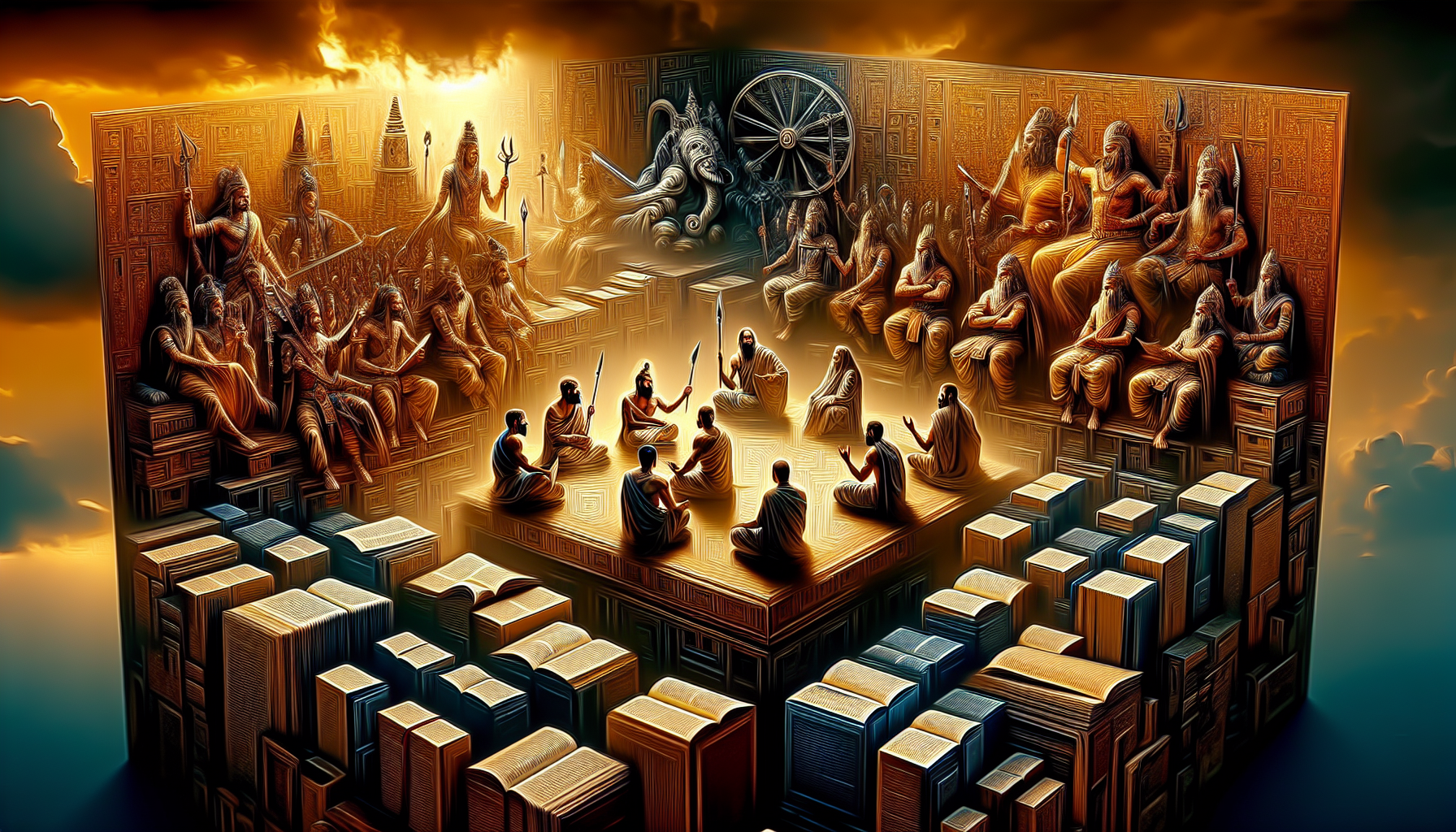
Have you ever thought about the moral dilemmas in the Mahabharata? Moral dilemmas arise when characters face a crisis of choice between two equally compelling options, often questioning concepts like Dharma, Karma, Duty, and Righteousness.
On the 19th of May 2024, an online discussion unfolded with active members of Philotreat: Rushabh, Anoop, Ayesha, Devina, Sukvinder, Shubham, Karan, Anushree, and myself, Madhvi. We engaged in a thought-provoking analysis of the Mahabharata incident.
Listen to the recording here:
It’s in Hindi, so if you’re familiar with the language, you’ll enjoy it.
If you’re interested in joining our meetings, look no further and Join our WhatsApp Group. If you encounter any issues, feel free to message me at +91 7219791517.
Lets’ see the summary of our discussion here:
The discussion delved into various aspects of the Mahabharata, including the reasons behind its occurrence, the role of key characters such as Duryodhana, Karna, Dronacharya, and Ashwatthama. The participants analyzed whether the Mahabharata transpired based on karma or dharma and debated whether it was driven by revenge. They also pondered why Sri Krishna sided with the Pandavas and questioned whether the Mahabharata was merely a game of victory. The conversation also touched upon the meaning of dharma, the concept of who becomes a god, and the differentiation between religion and dharma. Additionally, the participants engaged in a discussion on Gyana, Karma, and Dharma, and the role of duty, pondering whether everything was predetermined.
Here is the transcription of the recording (in English):
Rushabh:
Why did the Mahabharata happen? Why was there an internal feud and the thought of destroying one’s family? Both the Pandavas and the Kauravas suffered losses.
Madhvi:
The Mahabharata contains everything—feud, romance, action. The Pandavas lost the game of dice, so they had to endure the mistreatment by the Kauravas because they were Kshatriyas and could not refuse. The Mahabharata was not random but based on past karma. It illustrates the cause-and-effect relationship.
Rushabh:
The Pandavas lost and had to undergo 12 years of exile and keep their identities secret for 1 year. Before the battle, the Pandavas sent Sri Krishna to negotiate a settlement, but Duryodhana didn’t accept and mistreated Sri Krishna.
Rushabh:
Dharma was not always upheld, otherwise the Kauravas would have followed proper conduct.
Madhvi:
The Kauravas never followed dharma. When the Pandavas asked for their property back after returning from exile, the Kauravas rejected their request and didn’t return what belonged to the Pandavas.
Rushabh:
Yes, that is why the war happened.
Madhvi:
Sri Krishna even said that the war could not be avoided. But during the war, many actions were unethical and unavoidable. The attack on Karna was unethical and not based on dharma. Sri Krishna explained that Karna suffered in the war because of his past life karma, where he had killed an innocent cow in the forest.
Rushabh:
Even Dronacharya was attacked unethically. But Sri Krishna justified it by saying that Abhimanyu was killed unfairly, so Dronacharya’s attack was a form of retribution.
Rushabh:
Shakuni had a magical piece of bone, which he used to initiate the entire Mahabharata conflict. Misconduct also happened to Gandhari’s family. Bhisma Pitamaha was attacked unjustly. He would never attack a woman, so Shikhandi (half male-half female) was placed in front of him, causing Bhisma Pitamaha to leave the battlefield. Thus, we see both dharma and adharma at play. For instance, Jarasandha could not be killed in daylight, so Sri Krishna made the sun disappear temporarily to kill him, which was a form of trickery. The immorality seemed to be an injustice to the Pandavas. Yudhishthira also told a half-truth to Dronacharya, saying “Ashwatthama is dead,” referring to an elephant named Ashwatthama.
Madhvi:
So, my point is, on what basis did the war of Mahabharata happen? Was it based on karma or dharma?
Rushabh:
Basically, it was about revenge. But we should understand the root cause of the Mahabharata.
Anoop:
It was Shakuni’s revenge. Gandhari got married to the blind Dhritarashtra. In protest, her family was house-arrested and given food for only one person. They decided to save the youngest, Shakuni, by giving him all the food. Shakuni survived while the rest of the family died. Shakuni’s father gave him an injury on leg to remind him of the necessity for revenge. The dice Shakuni used were made from his father’s bones, allowing him to manipulate and win the game.
Rushabh:
I will add on. The revenge started because Gandhari had a flaw in her astrology. She first married a goat because her future husband was destined to die due to astrological impacts, and she didn’t tell Dhritarashtra about it. When Dhritarashtra found out, he got angry and captured Gandhari’s entire family. The revenge started here. Before that, the Kauravas committed many wrongful acts, like trying to kill Bhima. However, the Pandavas were always safe because of the good people around them, like Vidura, and because Sri Krishna himself was there. Duryodhana cheated the Pandavas many times.
Madhvi:
The Kauravas tried to cheat the Pandavas many times, but it was their good luck, fate, or divine power that kept them safe. Why were they always safe? Is it divine leela or pre-decided events? Is everything predetermined? Has anyone written the series of Mahabharata with this in mind? Why was it all causal?
Rushabh:
There were multiple reasons. Sri Krishna was closely aligned with the Pandavas. He knew he had to save the Pandavas because they were righteous, so he always supported them.
Madhvi:
Sri Krishna was always in support of the Pandavas. When the war was beginning, both Arjuna and Duryodhana came to Sri Krishna to ask for support. Sri Krishna offered Duryodhana a choice between himself and an army of 100,000 soldiers. Duryodhana chose the army, while Arjuna chose Sri Krishna. So, we see that Sri Krishna was always in support of the Pandavas. Can we say that everything in the Mahabharata was planned?
Shubham:
Did Sri Krishna support the Pandavas because they were in the minority? Can this happen?
Madhvi:
It could be that they were in the minority and always followed the path of righteousness. We can see that the sons of Gandhari were cursed from an earlier time to always commit crimes. Because Gandhari did something wrong, her sons were also responsible for evil deeds. It was all pre-decided. What do you all have to say about this?
Rushabh:
We all are reading the Mahabharata. The message of the Mahabharata is that everything could be planned. But the core message is simple: we have to follow the path of righteousness or dharma. You could commit evils, but only for the cause of good.
Shubham:
Evil is evil, regardless of whether you do it for good or bad. It is always unethical.
Madhvi:
But it is not always possible to stay completely truthful.
Sukhvinder Ji:
If we consider it as a proposition, then we feel everything is good. If we consider it as a trick, then everything seems bad. We see contradictions. Accepting bad things to achieve good results is not possible. The one who does bad things has a bad impression in mind, so the result is bad. With fraud, good things are not possible.
Rushabh:
The Mahabharata and the Ramayana both give different messages. The Mahabharata guides us on what we should not do. The Ramayana guides us on what we should do.
Sukhvinder Ji:
There is no black and white. In philosophy, everything should be based on logic. Without logic, things are not good. Everything is logical and mathematical. We know the Mahabharata was written by someone. One person could not write it exactly as events were happening. It could not have been written precisely. If we cannot write events exactly as they happen in front of us, how could a writer have written it exactly? So, it has been manipulative. It has been written in a poetic and historical way. The world is mathematical and logical, but things that happen in a fraudulent way are not good.
Devina:
If the intention behind anything, as shown in the Mahabharata, is bad, then the results are not good. The same applies today. If we are debating with bad intentions, things will turn out badly. However, it’s not always the case. If you do something with good intentions, the result could still be bad, but that’s not always true. We are focusing on fraud, but if we are doing anything with bad intentions, things won’t turn out right.
Ayesha:
We are talking about trickery and fraud, and it’s generally seen as bad. However, when we talk about God, everything is fair in love and war. But if we commit fraud in war, should we view it morally or differently within the context of war? It is okay to say fraud is bad in an ethical sense and doesn’t bring good consequences or karma, but the Mahabharata is about war. What do you have to say about this?
Devina:
I think that people say everything is fair in love and war, so whatever has been done with planning in the war field is considered fair. However, many unnecessary things were unfair, especially those happening inside the home, which was wrong.
Ayesha:
Someone asked why Krishna sided with the Pandavas. I think this is the message: if you commit fraud, it is wrong. Krishna symbolizes dharma, karma, and wisdom. That’s why Krishna sided with the Pandavas because ultimately, they were fighting a just war, the Kurukshetra war. The message is layered. If we study the Mahabharata by isolating trivial actions, we can grasp its essence. We also need to focus on the Bhagavad Gita while discussing the Mahabharata.
Rushabh:
In all this, we got a very important thing: the Bhagavad Gita. It mentions many good things about what we should do and what we should avoid. If we talk about consequences, Krishna was also cursed that the Yadav dynasty would be finished. Gandhari also cursed him, saying that since you caused the death of my 100 sons, wherever you are, there will be no peace. Today, we can see these consequences in Afghanistan, for example.
Shubham:
In the Mahabharata, we pray to Sri Krishna and the Pandavas because they won. The victorious are often seen as just. If Karna hadn’t been cheated, he could have defeated everyone. He suffered initially. When Arjuna was practicing archery, Karna asked if he could join. Arjuna, knowing he might lose, said Karna couldn’t fight him because he wasn’t a prince. This all started with an unethical stance. Karna’s armor was taken away, and the power of the one-agni (one fire) ritual was nullified. Ghatotkach intervened, so all this was fraudulent. We pray to the Pandavas because they were victorious. Here, where I live, there is a village called Visrat, associated with Ravana. During Diwali, Ravana is not burned there. The victorious are worshipped. If Karna had won, we would be worshipping Karna, and temples of the Kauravas would be built.
Madhvi:
If the Kauravas had won, the world would be completely different. We would stop following dharma because we would see tricks and fraud everywhere. We would do whatever it takes to win quickly and seek pleasure. If the Kauravas had won, dharma would not have prevailed.
Shubham:
Then dharma would have existed but on the Kauravas’ side.
Madhvi:
You mean to say that the definition of dharma would have changed?
Ayesha:
What do you mean by dharma? Dharma is well described in the Gita and the Mahabharata.
Shubham:
Dharma is justice.
Ayesha:
But saying that dharma would have changed is wrong.
Shubham:
Dharma is justice for good. Those who are victorious are ethical.
Ayesha:
That’s not what the Mahabharata is based on. Dharma is also described as yoga in the Bhagavad Gita. Arjuna needs to follow his dharma, which means fulfilling his responsibilities. Dharma comprises every element of the universe. It is cosmic order. Dharma is the essence of the Mahabharata, a force that binds the universe together. Going against dharma is going against the universe. Saying that whoever wins represents dharma is a misinterpretation of the Mahabharata.
Shubham:
We see the Babarnama, which is based on victory and the story of victory, and it is revered.
Sukhvinder Ji:
The definition given by Ayesha on cosmic order is compelling. However, I think dharma is not just cosmic order. Where is the definition you mentioned written?
Ayesha:
It is written in the scriptures.
Sukhvinder Ji:
We are not discussing scriptures or the Rig Veda.
Ayesha:
Let me ask the philosophy students what dharma is.
Rushabh:
There are four pillars of dharma: truth, purity, speech, and donation. The Bhagavad Gita is based on these four pillars.
Shubham:
Truth was lost when Indra came to Karna and lied about his identity. So, the first pillar was destroyed there itself.
Ayesha:
This is where you asked the right question about truth. Truth is a goal, but it is not the only important thing. It is about achieving universal goals. Sometimes, we have to use wrong means to achieve the right end. We need to have a broader outlook.
Shubham:
In the Mahabharata, we are given choices between being good, evil, and bad. The Kauravas faced fraud, and Karna suffered losses. But the godly figure should not act deceitfully.
Ayesha:
Karna siding with the Kauravas was wrong.
Madhvi:
Shubham, you said that godly figures are based on likability. The ones we like most are popular.
Shubham:
Those who are truthful should be considered gods. In the Mahabharata, those who are popular are regarded as gods.
Madhvi:
When the Pandavas were dwelling in the forest, their popularity was greater. Yudhishthira was praised and seen as a Raja. He was liked by the people.
Shubham:
What happened in the end? Take Mahatma Gandhi Ji as an example; he faced racism at the start, but what happened in the end?
Madhvi:
Let’s get others’ opinions. Ayesha asked beautifully, what is dharma? The foundation of the Mahabharata is based on dharma.
Sukhvinder Ji:
Religion is different from dharma. They are not synonymous. Dharma is nature. For example, fire’s nature is to be hot, and water’s nature is to be cold. What is truth? If we dissect truth, truth is existence. Existence is truth. What exists is truth. The question is, I am, and so I speak. If we consider universality, eventually, we will not be here. In philosophy, something that stays forever is called a substance. Everything that happens is predictable. Apart from them, nothing else is possible. We can say events are based on nature. Humans may think they are interfering in the process, but it’s not so. It’s all the nature of events. If humans eat, it is due to biological needs. Everything in the Mahabharata is based on right and wrong. If a lion eats a goat, the goat is the victim. But if the lion doesn’t eat the goat, what will it do? So, there is no good or bad; it’s all about perspective. If a lion attacks a village, villagers think it’s wrong, but from the lion’s perspective, it’s not. If humans were not here, nothing would change. Everything is based on nature. In Bharat, we pray to stones because they appear like God. Praying to a stone has no effect. If we talk about omnipotence, if God is omnipotent, then life is definite. If life is not definite, then God is not omnipotent. Everything is fixed. If we are angry with someone, why is that? Even an illiterate person knows something, though he may not express it well, but there is common sense on which he operates.
Ayesha:
What I want is for people to think deeply about the concepts of Gyana, Karma, and Dharma.
Madhvi:
Your point is very valid. If we don’t understand the definition of dharma, what can we understand?
Ayesha:
We can say that the Mahabharata has been written over 800 years, so it contains many moral dilemmas and contradictions. To analyze it, we need meticulous study. From what I have read and heard, I am forming my opinion on this. Today’s discussion was quite enlightening.
Madhvi:
The points you made are very thoughtful. First of all, what is dharma? Is dharma religion, or is religion different from dharma?
Ayesha:
Religion is a modern concept. Dharma is an ancient concept, found in Hinduism, Buddhism, and Jainism. So, we cannot say dharma is religion; it is a concept.
Shubham:
In the Mahabharata, there was no concept of religion. Religion was not in existence. So, we cannot say dharma is religion. Dharma could mean victory or truth. If the Kauravas had won, then dharma would have been in their favor. The outcome defines the dharma.
Madhvi:
When dharma is present, justice happens. So, in the Mahabharata, dharma is based on Sri Krishna’s ideology.
Anoop:
I agree with Sukhvinder Ji’s definition. One should play their duty. Karan was not on the side of the Pandavas because he knew his duty was to side with the Kauravas. In the Mahabharata, tricks and frauds happened at a small level.
If we discuss Khatu Shaam Ji, he was the son of someone. His mother told him that his father was fighting in a war and asked him to go and help. Khatu Shaam wondered how he would identify his father. His mother assumed that the Pandavas were only five, so she presumed they must be losing, instructing Khatu Shaam to fight from their side. With this in mind, Khatu Shaam decided to support whoever was losing. However, Krishna Ji knew that if he joined the battle, the Pandavas would lose. So, Krishna stopped him, killed him, and placed his head at the mountaintop. Many fraudulent activities occurred, but ultimately, everything was predestined. Everything was predetermined, and Krishna Ji played a major role.
Shubham:
I believe the real definition of Dharma must be victory. Because in ancient times, our Dharma was survival. Greek mythology also portrays a similar hunter-gatherer narrative, albeit modified.
Madhvi:
Victory was the primary cause of everything.
Shubham:
I have divided the Mahabharata into six parts and found that it is not just a religion. In the Bhagavad Gita, there are references to Samkhya and Yoga. When I contemplate where justice originated from, Immanuel Kant posits that the principle of morality is high when a child is born. The concept of infinity exists in the child’s mind. Justice has been inherent in humanity since its inception on Earth. If there is natural justice, then anyone who lacks knowledge feels no pain. The distinction between good and bad lies in society’s implications. Bad people can change if knowledge is imparted to them. Essentially, bad arises due to societal influences. Freud suggested that if a mother doesn’t behave nicely, the child feels bad. Thus, the idea is that human beings should inherently be good.
Madhvi:
You’ve expressed it very well; legal principles follow human development. Does anyone else want to discuss Dharma, Karma, and how characters inspire us?
Karan:
There’s no concept of Dharma emerging after victory. It’s evident in the Bhagavad Gita when Arjuna inquires, and the concepts are clarified. Many experienced individuals understand the meaning of Dharma, but in simpler terms, if Sri Krishna tells Arjuna that Dharma is what wins. Today, our minds are complex and tend to complicate things. We’re just beings who have to perform our duty, selected tasks we must fulfill. So, this simple duty concept is defined in the Mahabharata.
Rushabh:
Essentially, Dharma is nature in a realistic sense.
Madhvi:
Let’s conclude our discussion. Thank you all for being so active in the discussion. To summarize, we’ve discussed the Mahabharata, the characters, and how their actions were based on duty, nature, or instructions. We’ve explored the basis of the Mahabharata’s journey and touched upon questions regarding revenge. However, the topic we’ve discussed today is vast, and one hour isn’t enough to cover it all. Regarding the concept of Dharma, some believe it’s based on nature, while others say it’s derived from conscience. Some attribute it to Sri Krishna Ji. We could also discuss Karma and whether we have free choice or not. Like Shubham said, everything seems based on victory. So, I believe we’ll continue the discussion in the next session. Please share your feedback on today’s topic.
Ayesha:
Firstly, I’d like to thank you for inviting me to this discussion. I thoroughly enjoyed it and felt enriched by being part of it. People possess a wealth of knowledge about the Mahabharata, and I hope they reconsider the questions we’ve discussed today. Engaging in such discussions is essential, as conflicting opinions propel our thinking and knowledge forward.
Sukhvinder Ji:
Questioning helps us discover new insights. If I read something and assume I know everything, I limit my understanding. However, through discussion and questioning, we can gain deeper insights. Discussion leads to acquiring new knowledge.
Ayesha: The Socratic method operates similarly.
Sukhvinder Ji:
Indeed, progress stems from critique. We should engage in criticism without hesitation.
Madhvi:
Without debate, knowledge stagnates. Tolerance diminishes, and we cannot accept alternative viewpoints. Engaging in discussions fosters tolerance.
Karan:
The questions on the Mahabharata and Bhagavad Gita were thought-provoking. Some may find them lacking in truthfulness, but surveys by scientists indicate the events hold scientific significance. Even NASA follows the knowledge from the Bhagavad Gita and Mahabharata.
Madhvi:
It was a meaningful discussion, and I’m grateful to all of you for participating.
If you enjoyed our discussion, join our WhatsApp group and become a part of engaging conversations.
Stay Connected with Philotreat
Have you checked our other platforms?
Thank you for being with us. Text us straight on any queries and we would be happy to help you out!


Drop your thoughts below!