
Our personalities are the main factor to which people pay utmost attention. People admire attractive personalities, but a defective personality is one that most try to avoid. We all have some flaws in our personalities. But these flaws become extreme when they harm an individual’s life. They can damage one’s reputation and well-being. To avoid the major flaws, we need to understand personalities in an easy way.
In this post, I will let you know the personality types and how well you could understand one. Many studies in psychology, both old and new, suggest that people’s personalities can be understood by examining five main traits. Researchers have explored this idea extensively. This idea has been studied a lot over time, with the main theory emerging in 1949.
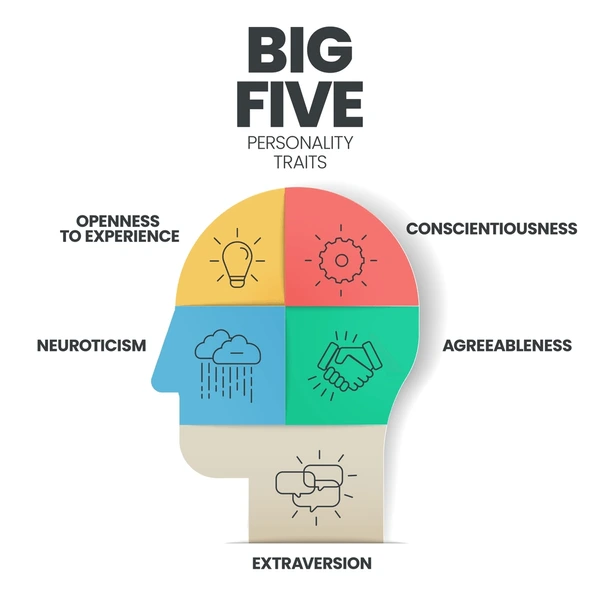
The five key personality traits are:
- Extraversion: How outgoing and social someone is in their interactions with peers, family, and the community.
- Agreeableness: It measures how kind and cooperative someone is in interactions, reflecting empathy, trust, and social harmony.
- Openness: How curious and open to new experiences someone is.
- Conscientiousness: It describes how organized someone is in their actions. They are careful in their decisions. This reflects their ability to plan ahead.
- Neuroticism: How anxious and emotionally unstable someone is. These traits influence their outlook on life and mental well-being.
History
The idea that five main traits define a person’s personality was first suggested in 1949 by D. W. Fiske. He believed that human personalities could be categorized into distinct dimensions to help understand individual differences.
Other scientists, such as Norman, Smith, Goldberg, and McCrae & Costa, expanded on Fiske’s idea. They conducted research on these traits. They identified five core traits known as the “Big Five,” which are openness, conscientiousness, extraversion, agreeableness, and neuroticism.
This model is pretty popular. People use it in all sorts of psychological tests and research. Using it helps us get a better grip on how humans behave and connect with each other. Plus, the theory has given us some cool insights into how personalities work normally and what happens with psychological issues.
Research
For a long time, scientists have tried to understand what influences human behavior by studying different personality traits. Researcher Gordon Allport identified over 4,000 traits. This large number was reduced to 16 key traits. These traits still remained quite complex. That’s where the idea of the “Big Five” personality traits came from. These are five broad categories that cover most of the ways people behave.
There’s been tons of research on these five traits. Scientists don’t always see eye to eye on what each of them really means.

The big five personality traits- Motivating Factors
1. Openness
Openness means being curious and creative. People who are open enjoy learning, exploring new ideas, and trying different experiences. They have a wide range of interests and like to try unusual things.
They’re also creative and comfortable with thinking outside the box.
Think of someone who always orders the most interesting dish on the menu. This person loves to travel to new places. They have hobbies you never would have thought of. That person probably scores high in openness.
People low in openness tend to prefer familiar things. They may find it harder to solve problems that require them to think differently.
2. Conscientiousness
Conscientiousness means being organized and responsible. People who are high in conscientiousness think carefully, manage their impulses well, and work hard to reach their goals.
People in fields like science or finance often have traits such as attention to detail and good organization.
Conscientious people plan ahead, consider how their actions impact others, and are reliable. They often work in project management or human resources, helping keep things organized and running smoothly.
Think about that buddy who always sets up your hangouts ahead of time. They check in on you every now and then. They really care about how life’s treating you. That’s a sign they’re probably pretty conscientious!
People low in conscientiousness dislike routines and schedules, often put things off, and may struggle to complete tasks on time.
3. Extraversion
Extraversion is a personality trait that most people are familiar with. It basically means someone who gets energized by being around other people.
People who are extraverted are often talkative, assertive, and express their emotions openly. They’re usually the life of the party, enjoy meeting new people, and have a large circle of friends and acquaintances.
On the other hand, introverts prefer to spend time alone and find social situations draining. They might feel uncomfortable being the center of attention or making small talk.
Extraverts usually do great in jobs where they get to chat and connect with people. These jobs include sales, marketing, teaching, or even politics. They’re often born leaders and really dig being in charge.
4. Agreeableness
Agreeableness is about being kind, helpful, and cooperative. People high in agreeableness are trusting, altruistic (selfless), and affectionate. They enjoy helping others and are often willing to share, comfort, and cooperate. They’re also empathetic, meaning they can understand and share the feelings of others.
On the other hand, people low in agreeableness can be unpleasant to be around. They may be manipulative, unkind, and uncaring. They might not show much sympathy for others or take an interest in their problems.
People high in agreeableness often find careers where they can help others. This includes jobs like charity work, medicine, mental health, and volunteering for social causes.
5. Neuroticism
Neuroticism is a personality trait that describes how prone someone is to experiencing negative emotions like sadness, anxiety, and worry. It’s like having a higher sensitivity to stress and difficult situations.
People high in neuroticism often:
- Feel their emotions very strongly
- Have frequent mood swings
- Worry a lot, even about small things
- Find it hard to relax
- Overthink situations
On the other hand, people low in neuroticism are more emotionally stable and resilient. They tend to be calmer, less stressed, and better at handling challenges.
If you’re into personalities, check out our psychology category! If you dig our stuff, how about giving us a follow? That’d be awesome!
Thanks for subscribing! Don’t forget to check out our latest Book: Growth is Forever, But How to Become Yourself? It’s a must-read and you can grab it on Amazon, so be sure to check it out! Also, take a peek at our other cool posts here:
Ancient Indian Wisdom for a Just and Compassionate Society
Dr. Madhvi Rameshwar Prasad Assistant Professor, Centre for Jain Studies, JAIN (Deemed-to-be University), Bengaluru Researcher in Indian Philosophy, Comparative Religion, Ethics, and Consciousness “Civilizations survive not merely through monuments or military strength, but through the values they choose to preserve.” There are moments when a museum or an exhibition ceases to be just a collection…

THE SPIRITUAL KITCHEN
There is a curious contradiction in our modern kitchens. We speak of sustainability, yet our dustbins quietly tell another story. The silky threads of corn are brushed aside without a thought. The cob follows soon after. We savor the tender pulp of a drumstick and casually discard its fibrous shell. Vegetable peels, fruit seeds, herb…
Beyond Entertainment: The Forgotten Depth of Ahimsa
Today, our Department of Jainology, in collaboration with the Department of Journalism and Mass Communication at JAIN (Deemed-to-be University), organized a guest lecture by Dr. Surendra Singh Pokharna on the theme: “Need for Non-violence and Non-possession to Save the Environment and the Earth from Sixth Extinction.” The presentation was not merely an academic lecture. It…


Drop your thoughts below!