
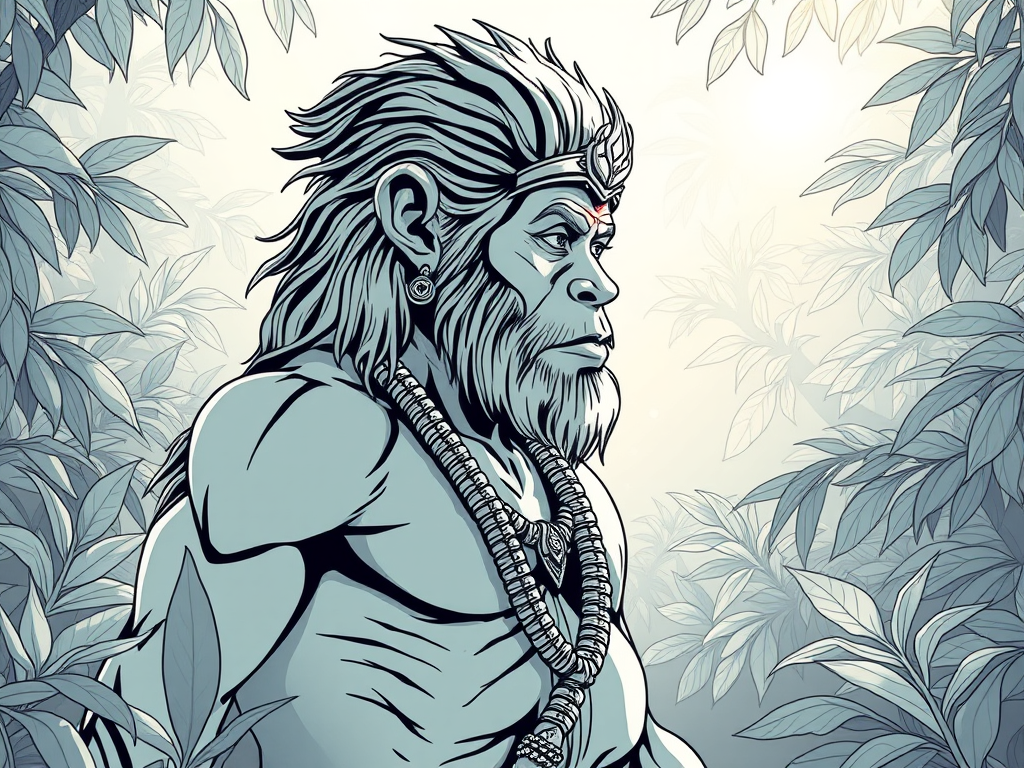
In this post, we’re excited to explore some character analysis from the Ramayana! We’ll highlight a few amazing characters like Hanuman, Rama, Lakshmana, Bharata, Sughriva, and Vibhisana. This insightful information comes from the book “Lectures on Ramayana” by Prof. V.S Srinivasa Sastri. Be sure to check out the original document here!
Hanuman
The curse of Hanuman is well known and evidently had other implications. Hanuman’s loss or failure of memory was not just limited to his strength but also affected necessary details at crucial times.
This amnesia became a source of weakness for him.
Instances of Hanuman’s amnesia:
- Forgot Rama’s promise to Sugriva to bestow Vali’s kingdom on him and suggested Tara’s support for Angada’s accession to the throne.
- Forgot the description of the herbs he needed to fetch to revive Lakshmana.
- Failed to return to Rama from Nandigrama and report about Bharata’s attitude.
- Omitted Sita’s ordeal in his narrative to Bharata.
Among Hanuman’s notable failures:
- Failed to convince Tara to support Angada’s coronation.
- Failed to persuade Angada to return to Kishkindha instead of staying near Svayam Prabha’s cave.
Further lapses included:
- Failed in his attempt to persuade Sita to ride on his back and return to Rama.
Hanuman’s Exploits:
- Hanuman explains his origin to Sita, with Jambavan reminding him of his early exploits, which earned him boons from Brahma and the devas.
- His greatest feat was the leap to Lanka and the incredible achievements that followed.
- He displayed his prowess in battle, especially against Ravana, with Rama receiving the honors of the day, but Hanuman also proved instrumental.
- After the ravages caused by Indrajit’s Brahmastra, Hanuman fetched the herb-hill from the Himalayas and restored it in Lanka.
Hanuman’s Confidence and Pessimism:
- Hanuman displayed a mix of shyness and courage about the trip back from Lanka.
- He showed the monkeys’ war boasts before starting the quest.
- Hanuman secretly went to Ravana with a strong warning.
Rama’s Appreciation of Hanuman:
- Rama praised Hanuman during their first meeting in Risyamukha.
- Rama entrusted Hanuman with the ring, showing his full confidence in him.
- When Hanuman returned from Lanka with Sita’s chudamani (lotus-shaped Indian headdress that is usually studded with jewels), Rama praised him and embraced him.
- Sita, after Rama’s victory over Khara, also greeted him with affection and praised his courage.
- At the coronation, Sita gifted Hanuman a pearl garland.
- Rama rewarded Hanuman after the conclusion of the coronation festivities.
Hanuman’s Search for Sita:
- Hanuman reduced himself to the size of a cat to search for Sita in Lanka.
- He mistakenly rejoiced at the sight of Mandodari, thinking she was Sita.
- Despite moral scruples in Ravana’s harem, Hanuman overcame them with reassurance.
- When Hanuman did not find Sita, despair initially seized him, but he regained hope and confidence.
- Eventually, Hanuman discovered Sita in the asoka grove, reflecting on Rama with tender thoughts.
- After careful reflection, Hanuman wisely decided not to appear suddenly before Sita. Instead, he spoke of Rama in her hearing, which served as the best introduction.
- He won her ear, though she remained suspicious at first. Gradually, Hanuman gained her confidence.
Lakshmana
- Rama loved Lakshmana more than Sita. This was special. Rama showed his feelings when he grieved for Lakshmana after Indrajit’s arrows hit him and when Ravana injured him. Sita realized this and told Hanuman that Lakshmana mattered more to Rama than she did.
- Rama and Lakshmana were different. Rama prioritized duty and righteousness, defending his principles against challenges from Kaikeyi and Sita. In contrast, Lakshmana was entirely devoted to Rama and rarely thought about anything else.
- Lakshmana had notable traits: he was loyal to Rama, watchful, hardworking, quiet, sometimes quick to anger but quick to apologize, generous, and shy around women. Sumitra advised him to see Rama as a father and Sita as a mother, which Sita confirmed to Hanuman.
- Rama showed great affection for Lakshmana, especially when Lakshmana built their hermitage at Panchavati and when he defeated Indrajit. Lakshmana’s shyness around women was evident, as he couldn’t recognize Sita’s jewelry and was deeply upset when Sita, whom Rama had left, asked him to witness her pregnancy.
- Sita described Lakshmana as strong but reserved. However, he could also lose his temper, especially when it affected Rama. In Kausalya’s room, he expressed his anger at Rama’s sense of duty and suspected a conspiracy involving their father and Kaikeyi. He threatened to chain or even kill his father if necessary.
- Lakshmana was not easily swayed by Rama’s calm acceptance of fate, but he wouldn’t act without Rama’s command. When Rama asked him to stay back for the sake of Kausalya and Sumitra, Lakshmana insisted that he had already been given permission to join Rama in the forest.
- Lakshmana’s criticism of Rama’s ideals was significant, especially after Indrajit killed a fake Sita. In that moment, he rejected Rama’s duty and suggested pursuing personal goals instead.
- Lakshmana had a remarkable ability to calm down quickly. This was clear when he was furious in Sugriva’s palace and then apologized after Tara soothed him. He faced challenges when Sita sent him away from Panchavati to assist Rama and when Durvasas threatened curses for not seeing Rama. Lakshmana had tough choices to make, and after some disobedience, Rama reprimanded and later banished him.
- In the end, the lesson is that one must face the consequences of their actions.
Rama
The strongest evidence of his moral superiority is how he treated Sita. The world, though surprised by what happened, did not speak out. They quickly accepted Sita’s suffering as a part of fate.
Consider these incidents:
- Despite warnings from advisors like Lakshmana, Rama protected Vibhishana.
- After defeating Ravana, Rama decided to let him go.
- When Vibhishana refused to perform Ravana’s obsequies, Rama decided to do them himself, showing his sense of duty.
These examples show the high moral standards and greatness achieved by Rama. It’s no surprise that the world admired him—he was almost perfect.
Almost, because he still had human traits like emotions and weaknesses. He felt anger, sadness, and despair like everyone else. Sometimes, he said hurtful things to those he didn’t trust and didn’t always show his best side. However, these moments don’t lessen Rama’s greatness. Instead, they help us connect with him by showing these human qualities. If we can’t reach his level, can we at least learn to control ourselves and be inspired by his noble example?
Events from Rama’s life show his human traits, highlighting his kindness and goodness:
- With Sita, he looks forward with pleasurable anticipation to his coronation as Yauvaraja.
- When that hope is dashed to the ground, he is disappointed, but he shows restraint. The poet notes that he controlled the feeling within his heart and went to his mother to tell her.
- When he has to part from Sita, he can hardly control his grief.
Rama shows his human side. He asks Lakshmana to stay. Lakshmana should protect their mother from Kaikeyi’s mistreatment and Bharata’s anger. In tough times, he also feels doubt and uncertainty like we do.
Rama has small flaws that show he is human.
He asks Sumantra to tell Dasaratha a lie. He wants Sumantra to say that the old king’s shouts went unheard when he tried to stop the chariot. He also uses tricks to avoid the constant demands of others.
Rama represents the best of humanity—as a son, husband, king, and friend. His self-sacrifice is clear when he accepted exile at a young age without complaint. He kept his moral integrity and earned respect from everyone.
Rama felt sad, especially when he had to share bad news with Sita and after her abduction. He also showed impatience while waiting in the Prasravana cave, showing his human side and empathy for others.
Valmiki skillfully shows these complexities, making Rama a relatable character who strives to balance admirable traits with human flaws.
Hanuman, who helps Rama because he wants to and Sugriva because he has to, tells Sugriva it’s time to search for Sita.
However, Rama gets angry at Sugriva for being lazy without asking about the situation. In a rush of emotions, he threatens Sugriva without knowing the full story.
Lakshmana also gets angry and threatens to kill Sugriva, but Rama calms him down and asks him to stop.
Tara then convinces Lakshmana to change his mind. Lakshmana agrees and apologizes.
When Sugriva comes with Lakshmana, Rama speaks kindly to him and accepts his apology.
This shows Rama’s noble character shining through.
Again and again, Sri Rama fights against his lower feelings and chooses to act from a better place.
Rama’s generosity is shown in another example during the war council, where they discuss whether to accept or reject Vibhishana.
Valmiki presents Rama in a way that helps us understand him.
“Was Rama always ideal in all situations, great or small, for everyone? If so, he was not real but rather a figure without life.”
Valmiki didn’t create Rama; he discovered him and brought him to life. Even the stories that surrounded him were part of his character. He wasn’t able to leave out events that seemed not to fit with Rama’s persona. Still, there is a strong sense of consistency and clarity in how Valmiki portrayed him, placing him among the world’s great authors.
So, what does Rama represent today?
He represents the best in a man—as a son, husband, king, and friend to the oppressed.
For instance, when he was about 25, he willingly went into exile without showing sadness. He ignored pleas and advice, emphasizing the importance of keeping promises and following rules. His strong moral character taught his family and subjects to be righteous, earning their respect.
Even when he felt hopeless, he didn’t show disappointment outside, but he was still sad inside. The Poet notes that he hid his feelings when telling his mother the news..
Here, we see Rama’s better nature.
Rama tells Bharata he is the true brother and reminds him of their father’s promise about the throne for Kaikeyi’s children. This promise troubled Dasaratha because he worried about Bharata causing issues and wanted to crown Rama while Bharata was still young.
- The oldest son in the Ikshvaku lineage becomes king.
- Kaikeyi’s wrongdoing, which Bharata condemns, should not take precedence.
- Everyone wants Rama to be king.
Rama tells Bharata not to criticize their mother, saying “Mother is as good as Father,” and he praises both as good people. Rama strongly opposes Jabali’s materialistic views.
Vasishtha, despite being wise, disagrees with Rama’s exile and tells Bharata to take the throne, which Bharata opposes. Bharata promises not to eat and to live on grass until he is heard, but Rama disapproves, saying it’s not suitable for a warrior. Bharata then suggests spending the same fourteen years in the forest as Rama, but Rama firmly declines after talking to the assembly, who recall his strong arguments.
Although reluctant, Bharata admits his unworthiness. Rama appreciates Bharata’s humility, stating it shows true capability and defends Kaikeyi. Bharata then presents Rama with gold sandals, which when worn transfer magical power.
Bharata treats the sandals as symbols of royal authority, taking them back home. Ultimately, Rama earns respect, while Bharata obtains legal power and rules the kingdom with Rama’s sandals guiding him. The writing reflects strong emotions, straightforwardness, and beauty in speech, skillfully merging language and meaning.
Key Points for Discussion:
(i) Was Rama hiding? The text shows that Rama agrees with his actions, comparing them to a hunting situation where princes have some freedom. Govindaraja, a loyal follower of Rama, also supports this view.
(b) Was this right? Hanuman thought it was wrong to attack Ravana while he was busy with Nila. Likewise, Vali was focused on Sugriva and didn’t see Rama, making the attack even more dishonorable.
(ii) Why did Rama not fight openly? Rama initially wanted to defeat Vali using many arrows and even suggested killing him without prompting from Sugriva. After demonstrating his strength by piercing seven sal trees, he decided to use a single arrow instead, especially after Sugriva was beaten and ran away. Rama believed Vali’s strength would be a problem in a face-to-face fight, so he opted to attack from a hidden spot.
Why wasn’t Vali killed immediately? Rama claimed he couldn’t tell the brothers apart during their fight, but this seems like an excuse. It’s also possible that Rama was torn between a fair fight and hiding; ultimately, he chose the latter.
Why not ally with Vali? Kabandha mentioned Sugriva and advised Rama to ally with him. Rama and Sugriva connected through shared suffering since both had lost their wives. Vali, meanwhile, was powerful and loyal to Ravana, which made him an unsuitable partner.
(v) Rama’s claims of power might not match today’s values. We should assess him based on the standards of his own time. ‘La gloire’ was a key belief for Kshatriyas, and it was normal for him to expand his rule. Rama thought he deserved to decide Vali’s fate. He believed he had that right since he had given power to Bharata, who was supposed to act only as a regent.
(vi) Was death the right punishment for Vali regarding Ruma? Killing Vali might seem against natural justice. This situation reminds one of wrongful punishments in history.
(vii) Rama’s inconsistent feelings towards Ruma versus Sita are noteworthy. He showed care for Ruma, who had been with Vali, yet lacked compassion for Sita, his own wife, despite her innocence being known publicly.
- The story that Sita vanished when Ravana arrived in Panchavati and that the Sita after that was a fake should be dismissed as unfounded.
- The claim that Sita’s troubles were self-inflicted by her behavior towards Lakshmana should not be respected and should be disregarded.
During a sad scene, Rama tells Vibhishana to bring a decorated Sita, reflecting his inner turmoil. Though he claims to have removed her disgrace for family honor, he harshly states he feels nothing for her and she is free to leave, revealing his deep-seated doubts about her loyalty.
Sita’s desperate response, threatening to set herself on fire, is met with silence, indicating Rama’s strong authority. After Agni purifies her, Rama claims he never doubted her, which feels insincere given his prior harshness. His feelings waver; he initially rejects Sita due to his doubts but later regrets this after her purity is reaffirmed.
Rama gathers his brothers, expressing he’d rather die than be dishonored, showing Sita’s worth diminishes against his reputation. In that era, women were seen as their husband’s property, leading Rama to prioritize honor over Sita’s value and ultimately banish her.
This decline in Rama’s character culminates in his decision to quietly send Sita away, demanding loyalty from his brothers. His actions appear driven by jealousy, a potent emotion that can lead even noble individuals to commit regrettable acts. Rama and Othello share parallels, both noble figures unfairly doubting their wives, leading to extreme actions and subsequent regret.
Bharata
- In the Ramayana, the younger brothers take the thrones from the older ones. Sugriva and Vibhishana want their kingdoms, even if it means killing their brothers. In contrast, Bharata does not want the kingdom given to him. He offers it to Rama, and when Rama refuses, Bharata keeps it, eager to return it joyfully. This act of brotherly love brings tears to both the monkeys and the Rakshasas. Bharata stands out for his goodness.
- His main qualities include persistence, strong will, youthful energy, and being favored by his uncle. Unlike Lakshmana, who would bow to Rama after showing anger, Bharata inspires respect and admiration rather than love.
- Bharata has a strong personality, courage, self-confidence, and cleverness, as seen when he tries various tactics to convince Rama in Chitrakuta. He even reprimands the sage Vasishtha!
- When Kausalya accuses Bharata of wanting the throne and threatens to take away the fire rituals needed for King Dasaratha’s funeral, Bharata is deeply hurt. He remembers his father’s curses against anyone who wanted Rama to be exiled. This part of the poem illustrates a man’s duties and virtues. Ultimately, Kausalya forgives Bharata.
- Bharata’s idea of acting as a stand-in for Rama in the forest was not new; he had suggested this to his mother earlier as a way of getting back at her. Guha, who doubted Bharata’s honesty, becomes assured of his good intentions.
- Bharata is heartbroken when he sees where Rama and Sita slept and the gold dust from her jewelry. He vows to live as an ascetic but doesn’t initially change his clothes, wearing silk to pay respects to Bharadvaja. Later, he dresses like an ascetic when he meets Rama.
- Rama has deep faith in Bharata, expressing this belief to the grieving people and others, including Lakshmana.
- However, Bharata also shows unfilial behavior that is disappointing. He verbally abuses and curses his mother before knowing the whole situation. When he returns to Ayodhya, he insults her in harsh language and threatens her if Rama weren’t angry. Even after Kaikeyi shows she regrets her actions by visiting with Kausalya and Sumantra, Bharata remains unforgiving and tells Rama she is wicked.
- Rama passionately defends Kaikeyi at their farewell, teaching Bharata a lesson about duty to one’s parents. Rama bows to her, a gesture intended to remind Bharata of the importance of respecting his mother, regardless of her past mistakes.
Sughriva
Sugriva, in the early part of his life, was dominated by Vali and felt insecure and cautious. However, in the later part of his life, he grew stronger and became more confident in himself.
Hanuman laughs at Sugriva for his fear of Rama and Lakshmana, whom Sugriva mistakenly thinks are messengers from Vali. The term ‘sakhamrgatva’ seems more like a joke from the Poet than a noble comment from Hanuman.
Charges usually brought against Sugriva:
(i) Disrespect to Rama’s greatness: When Sugriva became friends with Rama, they paired off in conversations, along with Lakshmana and Hanuman. Some commentators think Sugriva disrespected Lakshmana, causing trouble for himself later. However, this pairing seems normal, and it’s hard to believe Sugriva intended any insult.
(ii) Lying about Ravana: Sugriva claimed he didn’t know much about Ravana, which seems incorrect. He should have had some knowledge, especially considering that Ravana stayed with Vali. Despite this, Rama didn’t doubt him, which shows that Sugriva was likely just struggling with his emotions during this tough time and wasn’t being deceitful.
(iii) Neglecting Rama’s mission: This accusation is shallow. Sugriva had already ordered the search for Sita to begin in a timely manner, asking Hanuman or Nila to help. His only mistake was living too lavishly for Rama’s comfort. Sugriva was cautious about Rama taking in Vibhishana, but when Rama insisted on protecting anyone who seeks refuge, Sugriva warmly welcomed him.
Sugriva’s greatness:
Before the bridge to Lanka was built, Sugriva promised to kill Ravana upon seeing him. He boldly responded to Ravana’s invitation. He rushed into battle, engaged Ravana, and even knocked off his crown. When Rama scolded him for this recklessness, Sugriva explained, “How could I stay quiet when I saw the man who took your wife?”
In battle, Kumbhakarna captured Sugriva, but Sugriva fought back fiercely, managing to escape despite being seized. Sugriva accomplished many feats, including defeating Kumbha, Virupaksha, and Mahodara.
Despite his achievements, Sugriva has some undeserved blame attached to him. He never cruelly punished others; even the monkeys who misbehaved were forgiven for their role in finding Sita.
Although Sugriva is impressive, there is some tarnish on his reputation. Some accusations made by Angada about Sugriva weren’t fair. However, one charge had some truth: Sugriva hastily closed the cave where Vali went after Mayavi, assuming Vali was dead, and he was rushed into kingship by his ministers. This decision showed a moment of weakness in his character.
Vibhishana
Was Vibhishana a traitor? No, he was a true devotee and a noble example of devotion to duty (dharma).
Sadly, some people, especially in North India, unfairly regard Vibhishana as a traitor. It’s important to understand his character correctly.
Vibhishana chose to follow Rama because he knew Rama was a good person and was there to help humanity. He left Ravana because Ravana was extremely wicked and harmful to others.
Some argue that since Ravana was bad, Vibhishana should have just cut ties with him instead of joining his enemy. But when it comes to good (dharma) and bad (adharma), you can’t stay neutral.
They also question why Vibhishana actively supported Rama. By joining Rama, Vibhishana was right to help ensure that good triumphed over evil.
Finally, they ask why he accepted the crown of Lanka. Instead, we should ask how he could refuse it. Lanka was in ruins, and Vibhishana was the only remaining member of the royal family. He accepted the kingship not out of ambition, but because the land needed a wise ruler. His taking the crown was an act of service, not selfishness.
Vibhishana was not betraying his country; Rama was not going to take over Lanka but restore it to its rightful leader. Therefore, calling Vibhishana a traitor is incorrect.
We can compare Vibhishana’s situation with Sugriva’s: “Why was Vibhishana crowned beforehand while Sugriva was not?” Sugriva was an ally whom Rama sought for protection, but Vibhishana sought Rama for refuge. Sugriva had a strong bond with Rama and brought a massive army to fight, while Vibhishana brought a small number of advisors.
Sugriva was essential for conquering Lanka. Vibhishana’s support was unexpected. Sugriva didn’t know Rama well and even tested him, but Vibhishana was already devoted to Rama.
Sugriva was crowned immediately after a significant event, while Vibhishana was honored after a great battle. Rama ordered a token ceremony for Vibhishana, which would become official after the defeat of Ravana.
Sugriva had guarantees of support, while Vibhishana held onto hope. Sugriva’s help came after his coronation, while Vibhishana’s was beforehand.
Sugriva was seen as equal to Rama, while Vibhishana had a lower status, but he was loved and trusted by Rama and his brothers.
When Vibhishana approached Rama, Rama didn’t immediately recognize him. Surpanakha had referred to Vibhishana positively, and Hanuman had shared how Vibhishana’s family had helped Sita.
There was a strong conflict between Vibhishana and Indrajit, Ravana’s son, who praised patriotism while dismissing Vibhishana’s values. Vibhishana offered timely insights, especially during battles, helping Rama’s forces against Indrajit.
When Vibhishana aimed at his nephew, he felt conflicted yet remained devoted to Rama. His contributions included warnings and valuable suggestions, especially concerning magic.
He actively fought in battles, managing to unseat Ravana in a crucial moment. He also felt remorse after Ravana’s death and sought Rama’s permission to perform last rites for him. Rama eased his doubts.
In summary, Vibhishana was no traitor. He holds a significant place among the eternal heroes (chiranjivis).
Hope you enjoyed this summary. Don’t forget to subscribe to our blog for more insights.


Drop your thoughts below!