
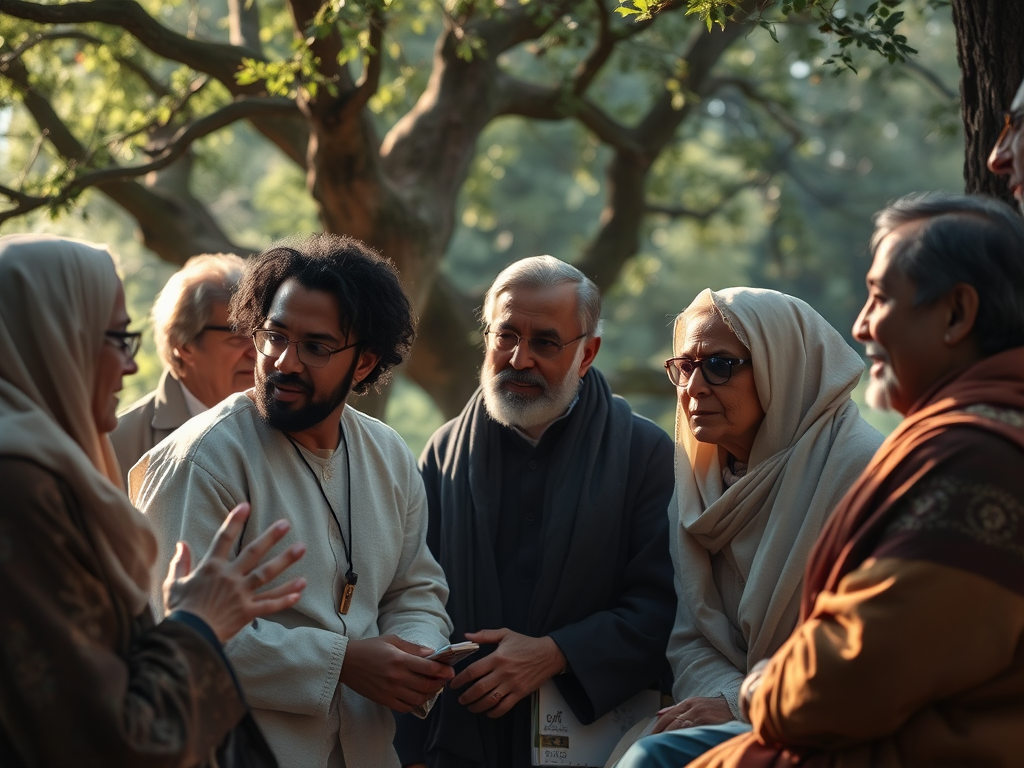
We had a great time discussing the topic of “Soft Naturalism” among academics of “Philotreat” and “The White Tower” Communities the other day! When these communities come together, nothing is left unanswered! Here are some arguments we have collected to address some particularly challenging questions that arose during our online session, specifically regarding our approach as alleged Soft Naturalists.
Below, there is a brief description of our participants and honored guests:
Dr. Daniel Dal Monte from USA
https://www.linkedin.com/in/daniel-dal-monte-03b63867
Dr. Madhvi Prasad from India
https://www.linkedin.com/in/drmadhviprasad
Ph.D Candidate Despoina Mandratzi from Greece
https://www.linkedin.com/in/despina-mandratzi-803897a5
Ph.D Candidate Aisha from India
https://www.linkedin.com/in/a-isha-mononymous-062692316
Writing and editing of the interview by Dimitrios K. Rinis, Founder of UPC The White Tower
chttps://www.linkedin.com/in/uniphcommunitythewhitetower
Note: For browsing the content without ads, you could download the content and read here.
Why is Soft Naturalism called non-reductive?
Soft Naturalism does not insist that everything must be explained (as if reduced) in terms of physical or scientific laws. There might also be other ways of explanation.
Why is it called Soft Naturalism?
This form of Naturalism is called “Soft” to distinguish itself from “Hard” Naturalism. This is based on the principle that everything is natural and can be investigated through scientific inquiry. We are biological creatures, products of biology, but we have these new ideas and practices that make us independent from biology.
In what sense are we independent from biology?
We can form ourselves, independent of the biological. We can shape culture, and that’s how we find meaning. We build our practices through historical situations and throughout moments. However, our idea of what nature is part of our culture!
Does it acknowledge the importance of metaphysics, Kant’s theory, and a transcendent being?
It allows you to appreciate abstract ideas that are not physical, good, or bad, ideas of human dignity; you can’t see or touch human dignity, it is not tangible, you can still believe it without adopting an idealist metaphysics. Soft naturalism denies Kant’s theory. Noumena are beyond possible experience; humans can’t possibly experience, like the idea of God, a transcendent being. Any kind of aspiration, to think about what could be beyond the natural, beyond our experience, makes no sense for the Soft Naturalism, which dismisses that idea.
To go a bit deeper, according to Soft Naturalism, are we mainly biological or transcendental?
We are not completely biological, but neither transcendental. We are cultural beings; we have customs, practices, and language. Your biology does not determine what language you speak. It is part of a culture, it is NOT a response to something transcendental, beyond the natural. This is why we are historical, cultural constructions.
Max Weber’s theory leads to a disenchantment of traditional humanistic theories, due to the rise of science. There are different forms of Naturalism which try to fill the gap between the scientific worldview on the one hand and the humanistic worldview on the other.
Is Naturalism acting as a go-between and a reconciliating force, and which explanation of Naturalism would best bridge that gap?
Soft Naturalists walk on a tightrope combining both worldviews: the scientific view in which God seems to have died and the humanistic view, which seems distinct and portrays human beings as outsiders in the universe. In the first case, Nietzsche says that the world is no longer infused with a higher purpose. It seems to be a material thing. In the second case, according to Soft Naturalism, we have these ideals and aspirations which seem to be alien to the mechanical stuff of the universe.
So, Soft Naturalism tries to preserve both insights. We accept a naturalistic metaphysics (only natural elements exist, as studied by natural sciences), but at the same time, we accept the independence of the humanistic view. To elaborate a bit further, we are independent from biology thanks to our intentional domain, all of our beliefs, desires, intentions, perceptions, ideas, activities, which contrast with states of matter. We are biological creatures, but we have these new ideas and practices that make us independent from biology.
So, if there were two circles, namely “natural sciences” and “human sciences”, would they be overlapping circles creating a shared area called “cultural domain’? Or does the “cultural domain” represent a separate third circle?
The cultural domain has a “sui generis” substantiality; it is independent, it is not atoms whirling around mindlessly. The human sciences (philosophy, literature, religion) are discontinuous from natural sciences (physics, chemistry, biology), we can’t explain human behaviour in terms of some sort of biochemical process.
So, if Soft Naturalists try to balance both insights of “natural sciences” and “humanistic sciences”, occupying the middle ground of the cultural domain, does the metaphysical realm fit in their theory?
Soft Naturalists do not think like Sri Aurobindo, Plato, or Hegel do. Sri Aurobindo believes in a future where humanity transcends its limitations and reaches its divine origins. Plato has the physical world in space and time, but there is a higher level of forms, which provide the basis for value, for normativity. Hegel believes in the cosmic spirit, a spirit higher than the natural, which accounts for the phenomena of consciousness and value. Sankara is the observation of plurality (like in science), which is just a partial view of what is fundamentally a unity, non-dualism. You can have a different metaphysics to account for the same observations. The above views constitute a sort of idealism. This is not the case for the Soft Naturalists. Again, we can explain the works of Shakespeare as just a manifestation of atoms moving around, and they just come together and produce by chance, a kind of implausible position. It is surreal, it does not make sense. It does not capture the reality of value. We tend to think in terms of good and bad.
Can we explain that in terms of a material process, the way Hard Naturalism does? Is something that has dimensions in space? Can you touch it or see it?Does this open the way for normative judgment?
Yes, Normative Judgment is not reducible; we don’t explain norms in terms of little atoms that have no consciousness, producing something higher. There IS Normative Judgement, there IS human culture, independent of the natural level. But, there is STILL a variety of naturalism, and it is NOT Idealist. And when we say, Soft Naturalism is STILL “Naturalism”, we mean that, as Soft naturalists, we are not some being made in the image of God, like in Judeo-Christian position or Hinduism. Darwin says we come from the animals. Get rid of Hegel’s idea that we are entities coming from the absolute spirit, Hegel’s rhetoric of the absolute, a cosmic force, following the plan of God. But we can’t have a medieval naturalism either, like Aquinas, recognizing the reality of nature but rooted in a supernatural first being, integrating religion with philosophy.
Naturalism does not believe in God, there is no purpose of the universe, no soul or immortality, or any free will, no morality, purpose, or universal plan (Darwin). Whatever we plan is illusory; the behavior of our brain is not a proposal.
Can we organize our lives to add value to ourselves so as to get some personal fulfillment?
We can still have a form of transcendence as a soft naturalist. You can have a spiritual awakening, even if you believe in this disenchanted metaphysics, a world with no God or purpose. But Soft Naturalism is rooted in nature and is committed to a naturalist metaphysics. Nature includes a non-reducible level of value, consciousness, but there is no separate layer from the natural. There is no real immaterial soul, no consciousness that is independent of the physical, but they are irreducible phenomena. The idea of value can not be an ontological transcendence, a literal entity. SNs do not believe in “values coming from a divine image, or a supernatural orientation, good or bad, like moving closer to God”. Soft Naturalists say that it is still “naturalism,” but the “values” are nevertheless non-reducible. They are absolute!
Within that naturalistic framework, do you think that Soft Naturalism falls into a kind of sophistry?
The definition of nature is part of our culture and, as such, it should be subject to change. We should be open to revising it. The cultural is NOT the biological. It would generate relativism, there is no transcendence, and it is also independent of the biological. There is no higher power, no absolute values. When you say “you are objectively wrong”, it is not a natural law. We generate our culture, a kind of relativism, but at the same time, Soft Naturalists insist on “naturalism”, that they will NOT revise that! But normally, it would be subject to future examination. What Soft naturalism tries to do is to protect a naturalist metaphysics from a genuine inquiry. Nature is a cultural product, and, as such, shouldn’t we be able to revise it? But Soft Naturalists have to be committed to it as “naturalists”. They do not accept any further changes!
Is it culture or science that defines nature? We know that science has authority over nature and defines nature. Can culture redefine nature, and if yes, can we then accommodate consciousness, free will, and morality into SN without any problem? Is science independent of culture?
We have to search for the answer to the question “What is the nature of nature?”. The issue was never a matter of factual discovery but of “competing conceptual posits”. It is not a matter of observing or looking. It is a matter of interpretation. There were different ways of explaining what nature is in ancient cultures, which would see nature as full of gods inhabiting different things. Our ideas of nature could be more materialistic, made of matter existing in space and time, as a form of interpretation. Science is strictly objective, but it is also a product of human culture. There are metaphysical assumptions informing it. Now we think that material objects are the fundamental reality, but that can change; we could have a new idea later on, like material objects are ideas (Barkley).
In science, we are reaching some sort of objective, if not absolute, truth. Is science inherently relativist?
Science aims for objectivity and tries to uncover universal truths. On the other hand, there are historical and cultural contexts within which scientific knowledge is shaped. Science is not metaphysics. In Science, we are observing the empirical world, the planets, and biology. Metaphysics is an inquiry into the basic nature of reality. Maybe stars are material phenomena producing heat and light, but science does not tell us what the star ultimately is. Science deals with what is observable. Maybe there is a spiritual being that created the stars. Maybe a platonic form or noumena. Maybe everything is process, no substance.
How does Soft Naturalism explain the origin of the universe?
This applies to Medieval Naturalism. Soft Naturalists won’t accept that idea of cosmological origin and deterministic causation. We could still have transcendence in a naturalistic framework. You can still be humanist, value human experiences, and human beings have religious experiences. In other words, we accept the death of God but hang on to humanism. As a Soft Naturalist, you can say that those things are real, but without positing a supernatural entity.
Can Soft Naturalism explain human beauty and dignity?
Human dignity is an abstraction; it is intangible. Where does it come from? The idealists say that we are made in the image of God, belonging to this source of goodness, or, like Plato, who says we participate in the forms. Yet, Soft Naturalists deny idealism. They want to hang on to this idea of “naturalism”, as part of our culture, we create the idea because we are not strictly biological, but does it have any foundation at all? There is nothing objective about it; it could change from culture to culture, a kind of relativism to it. Nevertheless, human dignity is something objective, you can’t deny it! Human dignity is infused in human rights; you have to respect it even if you do not want to. Kant says, “We are not means, we are ends in themselves”. It is true of us, regardless of our culture, which could say “you are not fully human, due to racism or classism”. Not true! Unfortunately, Soft Naturalists do not have a way to explain it.
Is it possible to enlarge that circle of those who are dignified and worthy of respect, irrespective of color, race, social condition, and religious beliefs?
Because you are not less of a human being, whatever your experiences are. Human rights are grounded in human dignity after all.
Human beings have intrinsic dignity, regardless of their status. We have to respect people as an absolute. It is a part of our culture, not a product of biology or what is transcendent, as if it were flexible, and able to be reinvented or even denied to a certain class of human beings. It would have to be a flexible, provisional idea. People think that SOFT is very weak, but SOFT is very critical and thoughtful. Science can not define everything, definitely not values.
Soft Naturalism does not promise after afterlife or soul. We integrate a variety of experiences which are interpreted according to our perception mode. Choices also play an important role in the case of multitasking.
What is the relation between Soft naturalism and the purpose of Choices?
The Idea of Free Will (Transcendental Freedom) is this capacity that is higher than nature. We are not just a product of natural processes; we have a soul. This consciousness or soul is superior to matter; we can shape and mold ourselves through this power.
Soft Naturalism rejects this idea that we have this kind of supernatural power that helps us overcome our biological drives. They have to change the way we think of our choices. Our choices would be more modest. Soft Naturalists do not have the spirit to overcome matter and our biology. We have different ways of thinking about ourselves. From the first person perspective (εγώ), “I am doing things, I am thinking about myself as free”. From a 3rd person perspective, “I am a neurochemical, just a brain of electrochemical signals going on”. Soft Naturalists are going to reduce FREE WILL to a perspective, somehow reconciling the perspective of the natural sciences with the perspective of human life and experiences, admitting the value of both. Soft Naturalists strive to achieve what they are trying to achieve, but they are rooted in “naturalism”. Hard Naturalists also accept that perspective, not something genuine, is causal power. Hard Naturalists have a certain way of explaining themselves, but they are just physical phenomena.
Is it science that helps us understand the world, or is it culture, values, and philosophy that help us understand the world, apart from ourselves and others?
Scientism is the view that science can explain everything, but science is a product of culture; it is not metaphysics, you CAN’T use science to explain the ultimate nature of reality. You have to have philosophy. Can science access our consciousness? Can you use a microscope to look at someone’s thoughts? You can only see the brain, but the thoughts are hidden from science. Our very self suggests that there is an ultimate reality that science can not account for. You need philosophy, metaphysics to fully understand reality.
PS. This article on SOFT NATURALISM was inspired by the academic discussion we had with Pr. Daniel Dal Monte in our community the other day.
About Author:
Dimitrios K. Rinis is an educator (EN/GR), TESOL-certified teacher, academic, philosophy researcher, and author of the philosophical theory “ATLANTIS.” He is the founder of the Universal Philosophical Community – The White Tower, a platform that promotes global philosophical exchange through LinkedIn, YouTube, and Substack in both English and Greek.
He actively shares books, articles, and interviews from authors and thinkers worldwide and invites collaborations through Zoom interviews and public features.
📩 Contact: thephcommunitythewhitetower@gmail.com
🔗 LinkedIn – The White Tower
Youtube- Universal Philosophical Community The White Tower


Drop your thoughts below!