

Introduction: Did Jainism Always Have Two Distinct Visual Traditions?
The history of Jainism is often studied through the emergence of its two major traditions: Digambara and Śvetāmbara. Their differences are generally discussed in relation to monastic discipline, the practice of nudity, scriptural traditions, the status of women and the interpretation of renunciation.
However, an important historical question deserves closer attention: Did these visual differences exist from the beginning, or did they develop gradually over time?
Archaeological evidence, particularly Jain sculptures, inscriptions and bronze images, offers an interesting perspective on this question. Early Jain images do not always display the distinct visual characteristics that later became associated with Digambara and Śvetāmbara traditions.
The archaeological material presented in this discussion suggests that Jain visual representation underwent significant changes across different historical periods.
Screenshot of Ashish Vohra Ji’s class presentation on the current topic.

1. Early Jain Iconography: The Mathura Evidence (1st–3rd Century CE)
One of the most important archaeological sites for understanding early Jainism is Kankali Tila in Mathura, Uttar Pradesh.
The site has yielded numerous Jain sculptures, inscriptions and religious artefacts, particularly from the Kushan period.
A striking feature of the early Jina images from Mathura is their nudity. The Tirthankaras are generally represented without clothing or elaborate bodily ornaments.
This visual representation is significant because nudity in Jain monastic tradition is associated with renunciation, non-possession (Aparigraha) and freedom from material attachment.
The archaeological material also includes representations of monks described as Ardhaphālaka, who are shown with a cloth covering the forearm or body.
These representations remind us that early Jain monastic practices and their visual expressions may have been more diverse than later sectarian classifications suggest.
Philosophical significance: The representation of a naked Jina raises an important question: Is renunciation primarily an external practice involving the abandonment of possessions, or an internal transformation involving freedom from attachment?
2. The Akota Bronzes and Changing Visual Representations (5th–6th Century CE)
The second important stage is represented by the Akota bronzes from Gujarat.
These bronze images provide valuable evidence for the development of Jain iconography.
Some Jain images from this period are associated with representations of Jinas wearing a lower garment. This is an important development when compared with the predominantly nude Jina images found at Mathura.
Another interesting representation is that of Jīvantasvāmī Mahāvīra, in which Mahavira is depicted in a princely form, adorned with jewellery and royal attire.
This representation is particularly significant because it portrays Mahavira through an aspect of his life before complete renunciation.
It also demonstrates that Jain artistic traditions did not restrict themselves to a single visual form when representing the spiritual personality of the Tirthankara.
Philosophical significance: Can the same spiritual personality be represented through different visual forms without changing the underlying philosophical understanding of liberation?
3. After Vallabhi: The Development of Two Distinct Visual Codes
The Vallabhi Council, traditionally associated with the compilation and preservation of Śvetāmbara Jain canonical literature in the 5th century CE, is an important landmark in Jain history.
The archaeological argument presented in the classroom slide draws attention to the development of more recognisable visual distinctions between the two traditions in the later historical period.
Two broad visual conventions became increasingly identifiable:
Digambara visual tradition
- Tirthankaras are represented nude.
- Images are generally unadorned.
- The eyes are often depicted in a downward-looking or meditative expression.
- Nudity expresses complete renunciation and non-possession.
Śvetāmbara visual tradition
- Tirthankaras may be represented with a garment line.
- Some images have inset glass eyes.
- Images may include ornaments or other decorative elements.
- Festival-related adornments, known as Āṅgīs, form part of certain devotional practices.
These distinctions are important for understanding the development of Jain religious art and the relationship between visual representation and sectarian identity.
It is important, however, not to treat the Vallabhi Council as a proven single event that created these visual differences. The development of Jain sectarian identities and artistic conventions was gradual and involved multiple historical and regional influences.
4. What Do Inscriptions Reveal About Early Jain Communities?
Sculptures provide visual evidence, but inscriptions help us understand the communities that commissioned and worshipped these images.
The Mathura inscriptions are particularly valuable because they refer to Jain monastic and organisational lineages, including Gaṇa, Kula and Śākhā.
The classroom evidence highlights references to:
- The Kotṭiya Gaṇa.
- The lineage associated with Suhastin’s pupils.
- Vajra’s Deśī Śākhā.
These references are significant because they demonstrate that early Jain communities had organised religious structures and identifiable monastic lineages.
An especially interesting historical interpretation is that Jain communities associated with the later Śvetāmbara tradition also worshipped nude Jina images.
If supported by the relevant inscriptional and archaeological context, this challenges the assumption that nude Jina worship was exclusively associated with the later Digambara identity.
Historical implication: The early Jain community may have shared certain artistic and devotional practices before later sectarian identities became firmly established.
5. Important Archaeological Evidence
The following archaeological examples help illustrate the gradual development of Jain visual culture.
Lohanipur torso – Bihar
An important early sculptural fragment representing the Jain ascetic and Tirthankara image tradition.
Hathigumpha inscription – Odisha
Associated with King Kharavela, this inscription provides valuable evidence for the historical and religious environment of ancient Jainism.
Kankali Tila – Mathura
One of the most significant archaeological sites for studying early Jain iconography, religious communities and monastic lineages.
Chausa hoard – Bihar
The bronze Jain images associated with this hoard provide evidence of early Jain metal sculpture and devotional representation.
Hālsi inscriptions and plates
These are relevant to the study of Jain religious patronage and the historical development of Jain communities in Karnataka.
Akota bronzes – Gujarat
These bronzes offer important evidence for the development of Jain iconographic forms, including representations associated with the Jīvantasvāmī tradition.
Chandragiri – Śravaṇabeḷagoḷa, Karnataka
The inscriptions and sculptural heritage of this site provide evidence of the historical development of Digambara Jain religious culture in South India.
6. What Does This Archaeological Evidence Teach Us?
The study of early Jain iconography offers several important conclusions.
First, religious traditions do not always develop their distinctive visual identities at the same time as their philosophical foundations.
Second, archaeological evidence can challenge assumptions based solely on later religious classifications.
Third, inscriptions reveal that Jainism had organised communities, monastic lineages and systems of patronage well before the later visual conventions became firmly established.
Finally, religious art is not merely decorative. It reflects philosophical ideas, devotional practices, social relationships and historical developments.
The distinction between Digambara and Śvetāmbara traditions should therefore be studied through multiple sources, including textual evidence, inscriptions, archaeological findings and historical scholarship.
Conclusion: Beyond Sectarian Boundaries
The archaeological history of Jainism encourages us to look beyond the present-day distinction between Digambara and Śvetāmbara traditions.
Early Jain images, particularly those from Mathura, demonstrate the importance of studying the historical context in which religious representations developed.
The gradual emergence of different visual conventions reminds us that religious identity is shaped through historical experiences, philosophical interpretations, artistic practices and community traditions.
Perhaps the most important lesson is that the spiritual ideal of the Tirthankara cannot be understood only through external representation.
Whether depicted nude, clothed or adorned, the Tirthankara represents the ideal of liberation, self-discipline and freedom from attachment.
This also invites us to reflect on the Jain principle of Anekāntavāda: different perspectives and representations may illuminate different dimensions of a complex historical and philosophical tradition.
Discover Jain Philosophy Through Learning and Creativity
How can children understand the values of Jainism beyond memorising names, dates and religious symbols?
At PhiloTreat, we believe that philosophical learning can begin during childhood through stories, activities, puzzles, colouring and thoughtful exploration.
Our children’s Jain activity book:
The Life of Mahavira: A Jain Tirthankara Activity Book – Part 1
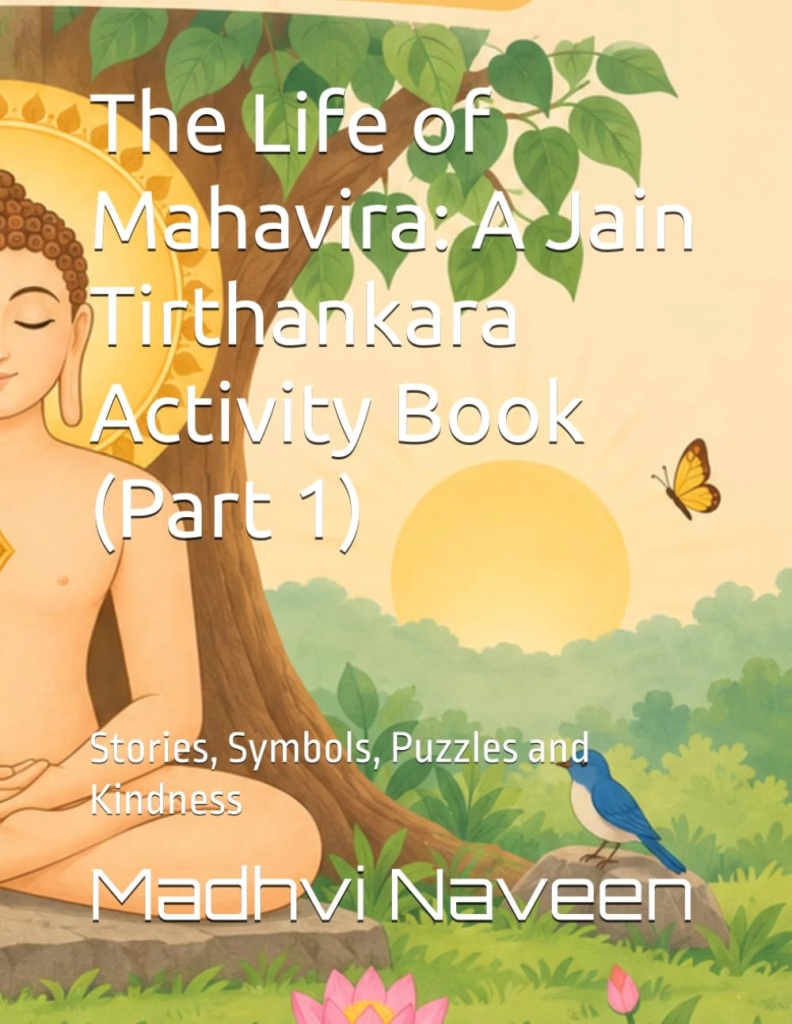
introduces young learners to the life of Mahavira and the foundational values of Jainism through engaging, child-friendly activities.
Children can explore:
- The life and teachings of Mahavira.
- Jain symbols and their meanings.
- The importance of Ahimsa and kindness.
- Stories, puzzles and creative learning activities.
- The values of compassion, self-discipline and respect for all living beings.
Whether your child is learning about Jainism at home or exploring Indian philosophical traditions for the first time, this activity book offers an engaging starting point.
Because understanding philosophy should begin with curiosity, creativity and compassion.
Explore children’s educational resources at PhiloTreat.
PhiloTreat – Treat Thyself Through Knowledge.


Drop your thoughts below!