
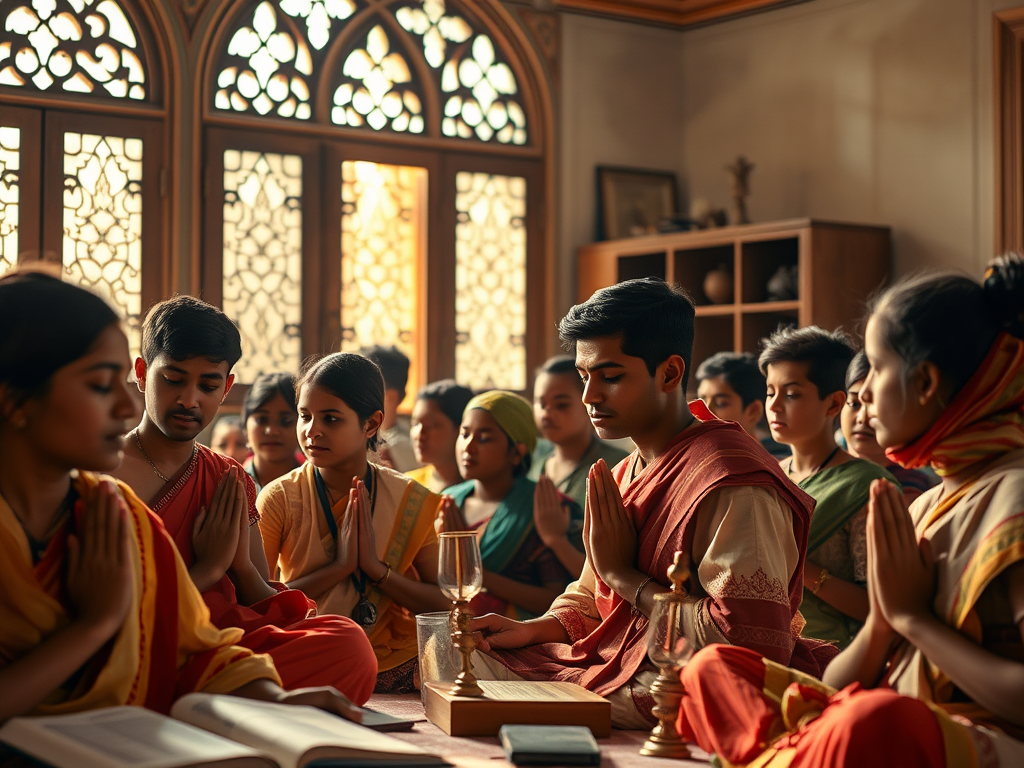
When it comes to exams, students usually freak out about what questions will pop up, how much they gotta study, and where to find the right info. So, to take some of that stress off, I put together a summary of the important stuff. Hopefully, this makes it easier for everyone to get ready and crush their exams!
Summary of Prayers
- Protection and Nourishment: A prayer for mutual protection and nourishment between teacher and disciple, promoting harmony and understanding.
saha nāvavatu । saha nau bhunaktu । sahavīryaṃ karavāvahai ।
tejasvi nāvadhītamastu । mā vidviṣāvahai ।
oṃ śāntiḥ śāntiḥ śāntiḥ ।।
May that ultimate power protect us both (Teacher & Disciple);
May that ultimate power nourish us both;
May we work in harmony with great vigor;
May our study be illuminating and fruitful;
May we not hate each other.
- Journey to Truth: A plea to transition from untruth to truth, darkness to light, and mortality to immortality. Here I have talked about this prayer in detail.
oṃ asato mā sadgamaya ।
tamaso mā jyotirgamaya ।
mṛtyormā amṛtaṃ gamaya ।
oṃ śāntiḥ śāntiḥ śāntiḥ ॥
Take me from the untruth to the truth
Take me from the darkness to the light
Take me from the mortality to the immortality
- Wellbeing for All: A wish for universal wellbeing, peace, fulfillment, and auspicious experiences.
sarveṣāṃ svastirbhavatu sarveṣāṃ śāntirbhavatu |
sarveṣāṃ pūrṇaṃ bhavatu sarveṣāṃ maṅgalaṃ bhavatu ||
May there be wellbeing for all,
May there be peace for all,
May there be fulfillment in all, and
May all experience that which is auspicious.
- Happiness for Beings: A desire for happiness for all beings everywhere.
lokāḥ samastāḥ sukhino bhavantu
May all beings everywhere be happy.
- Completeness: A reflection on the nature of completeness, emphasizing that from completeness, only completeness remains.
pūrṇamadaḥ pūrṇamidaṃ pūrṇāt pūrṇamudacyate |
pūrṇasya pūrṇamādāya pūrṇamevāvaśiṣyate ||
That is complete, This is complete, From the completeness comes the completeness.
If completeness is taken away from completeness, Only completeness remains
Purusharthas- Goals of Life
- Puruṣārthas: Four main goals of human life – Dharma (duty), Artha (wealth), Kāma (desire), Mokṣa (liberation).
- Dharma: Represents righteousness, moral conduct, and duty; essential for societal order.
- (धर्म – जो स्थायी और व्यवस्थित होता है- आचार, व्यवहार और नैतिकता का नियम। यह प्रकृति का कानून, विशेषतः गुण और कर्तव्य को दर्शाता है।)
- Artha: Refers to material prosperity and means of life.
- Kāma: Encompasses desires and pleasures, including love and enjoyment.
- Mokṣa: Signifies liberation from worldly existence.
- Types of Goals: Immediate, short-term, and long-term goals are essential for personal and professional development.
Pinnacle of selflessness and ultimate freedom
Do we know the worth of this life offered to us? The YOLO concept, which means “you only live once,” suggests that we seek happiness, but sometimes it becomes too much, leading to despair and sorrow.
Choice and freedom to choose have evolved since human evolution, with our mind constantly running through random thoughts and desires. Our actions manifest as choices, with consequences. The cyclic process of thoughts, desires, plans of action, choices, and consequences is a key aspect of our life.
What guides our choices?

The fourfold personality, Antahkarana, or the Inner Being, dictates this cyclical process, which is a reflection of our inner being.
- Manas: The part of the mind that vacillates, oscillates and is in a state of flux or fantasy and uncertainty. It struggles between resolutions and uncertainty.
- Buddhi: The intellect that decides based on a specific bank of memory or data. If manas likes buddhi’s outcome, the entire being falls in line and results in a pleasant experience; otherwise, it results in a struggle.
- Chitta: Storehouse of memory. A universal medium through which consciousness functions on all the planes of the manifested universe
- Ahamkara: Self-identity

Pic courtesy: The Purpose of Life, pg. 3, “Say Cheese!” – Witty Wisdom by Swami Chinmayananda
Let us see what some of the foremost personalities across the spectrum of society have to say about their purpose in life.


Let us look at the key takeaways from the above quotes.

Amma, Mata Amritanandamayi says in one of her satangs:
“Behind all great and unforgettable events in the heart. Love and a selfless attitude underlie all great deeds. Behind any good cause, you will find somebody who has renounced everything and dedicated their life to it.” [3]
Is there a User Manual to Life?

We are back to the question we asked at the beginning. Were we born with a user manual for our life? Did any Rishi, philosopher or wise person devise any framework? If yes, did they also stress the importance of selflessness as a virtue worth emulating at every stage of life?
The Four Ashramas
Sanatana Dharma has always created a perfect synthesis between ideological goals and the reality of material and physical life. One unique facet of Sanatana dharma is classifying a human being’s life ‘into ‘ashramas.’
Ashrama means “Way of Living.” There are four Asramas or stages in life [5], viz.,

- Brahmacharya or the period of studentship. It includes,
- Upanayana Ceremony: Marks the beginning of a student’s disciplined life.
- Daily Practices: Includes early rising, bathing, prayer rituals (Sandhya and Gayatri Japa), and physical exercise.
- Values and Conduct: Emphasizes humility, obedience, chastity, and respect towards elders.
- Transition to Household Life: Students present a gift to their preceptor before returning home.
- Final Instructions: The teacher imparts crucial life principles during a convocation address.
- Grihastha, or the stage of the householder,
- Grihastha Responsibilities
- Earning and Charity: Honest earnings with a commitment to donate one-tenth of income.
- Moral Living: Enjoyment of life’s pleasures must align with ethical standards.
- Pancha Maha Yajnas
- Deva-yajna: Offerings to deities.
- Rishi-yajna: Study and teaching of Vedas.
- Pitru-yajna: Rituals honoring ancestors.
- Bhuta-yajna: Feeding of animals.
- Atithi-yajna: Hospitality to guests.
- Family Values
- Respect and Care: Upholding respect for elders and caring for parents.
- Cultural Transmission: Ensuring the passage of spiritual and cultural values to future generations.
- Vanaprastha or the stage of the forest-dweller or hermit,
- Retreat to Solitude: The practice encourages individuals to find a quiet place for meditation, away from societal distractions.
- Detachment: This phase is characterized by an intentional withdrawal from social bonds and familial responsibilities, allowing for deeper spiritual exploration.
- Spiritual Study: Ample time is dedicated to engaging with sacred texts and philosophies, enhancing one’s spiritual understanding.
- Family Considerations: Individuals should ensure their family’s well-being before starting this spiritual journey.
- Sannyasa or the life of renunciation or asceticism.
- Definition of Sanyasa: It involves renouncing possessions, caste, and personal ties, focusing on serving the world.
- Sanyasa Ceremony: A ritual that symbolizes the relinquishment of worldly responsibilities and ties.
- Traits of a Sanyasi: Includes indifference to pleasures, freedom from desire, and a balanced, loving disposition towards all.
- Spiritual State: A Sanyasi achieves a state of deep meditation and ultimate freedom from societal conventions.


Each stage has its duties. These stages help the evolution of man. The four Asramas take humans to perfection in successive stages. The practice of the four Asramas regulates life from the beginning to the end.
Karma Theory
Karma Definition: “Karma” (कर्मन्) refers to actions or deeds, including everyday tasks, special duties, or religious acts. For an easy explanation video, click here.
Types of Karma: There are five motions associated with Karma:
- उत्क्षेपण (Utkṣepaṇa) – Upward motions
- अवषेपण (Avakṣepaṇa) – Downward motions
- आकुञ्चन (Ākun͂cana) – Contractions
- प्रसारण (Prasāraṇa) – Expansions
- गरण (Gamāna) – Movements from one place to another.
Karma Categories: It can be categorized into:
- Positive Karma: Actions motivated by kindness and compassion.
- Negative Karma: Actions driven by jealousy, anger, and hatred.
Core Teaching: “As you sow, so shall you reap” emphasizes the importance of the intention behind actions.
Benevolence: Good deeds benefit others, reflecting the idea that our actions should aim to help those around us, similar to how trees bear fruit for others.
- Types of Karma:
- Sancita Karma: Accumulated karma from all past actions.
- Prarabdha Karma: Karma that is currently manifesting in this life.
- Aagami Karma: Future karma that will result from present actions.
- For more understanding, visit Theory or Doctrine of Karma- In Brief
- Key Principle:
- The saying “As I sow, so shall I reap” highlights that our actions determine our experiences.
- The saying “As I sow, so shall I reap” highlights that our actions determine our experiences.
- Why Work?:
- We owe debts to nature, other beings, society, teachers, and ancestors.
- Working helps recognize and improve our limitations.
- How to Work?:
- Focus on fulfilling duties and avoid shortcuts.
- Work hard and aim to give back more than you take.
- Maintain a mindset of detachment from the results.
- Karma Yoga:
- Engage in actions without attachment for spiritual growth.“Nishkama karma Yoga”- Best advice from Lord Krishna !!
This journey highlights our responsibilities and the growth that comes from our actions!
References:
- Dharma Fundamental Way for Sustainable Living Part 1, https://youtu.be/C9TZHr_b1cM
- Anthahkarana/Chitta/Mānas – Sanatana Dhara, https://sanatanadhara.com/antakarana/
- Amma on Selfless service, https://www.amritapuri.org/6762/selfless-serivce.aum
- Brahmacharya and its importance in Sanatana Dharma, https://indiafacts.org/brahmacharya-and-its-importance-in-sanatana-dharma/
- The Divine Life Society » The Four Asramas – Sivananda Online, https://www.sivanandaonline.org/newsupdates/the-four-asramas/
- SATSANGHA: The Four Asramas of Hindu Dharma – Blogger, https://satsanghammu.blogspot.com/2010/03/four-asramas-of-hindu-dharma.html
- Sannyasa, in the service of the world – Amma, Mata Amritanandamayi Devi, https://www.amritapuri.org/14534/sannyas.aum
- Amma shares on Law of Nature and Life | amma.org – Mata Amritanandamayi, https://www.amma.org/news/amma-shares-law-nature-and-life
- Justice M.Rama Jois, Dharma – The Global Ethic (Chapter 1.5.5), DHARMA_The Global Ethic.pdf (google.com)
Don’t forget to visit Foundation of Indian Heritage Refresher Lessons II and Refresher Lesson III for your complete preparation for final exams.
Subscribe for notifications on exam notes and materials.


Drop your thoughts below!