
On Exhaustion, Meaning, and Authentic Dwelling
The Uncomfortable Club at Philotreat is a space for reflective conversations—where difficult, often avoided questions about life, meaning, exhaustion, and authenticity are not rushed toward quick answers. Instead, they are allowed to unfold slowly, through dialogue, presence, and philosophical inquiry.
In this session, we began by outlining a few key subthemes that shape our experience of modern exhaustion:
- Emotional backlog — the unprocessed stories and micro-stresses we carry within us, which silently accumulate and drain our energy.
- Inner fear and inner noise — the mind’s constant restlessness, making silence and rest difficult, and rendering practices like meditation deeply relevant.
- Existential overload — persistent questions about what we should do, who we should become, and how we should live, which intrude into everyday life.
- Identity incoherence — the burden of managing multiple roles at once: professional, personal, emotional, and social, often leaving us fragmented and restless.
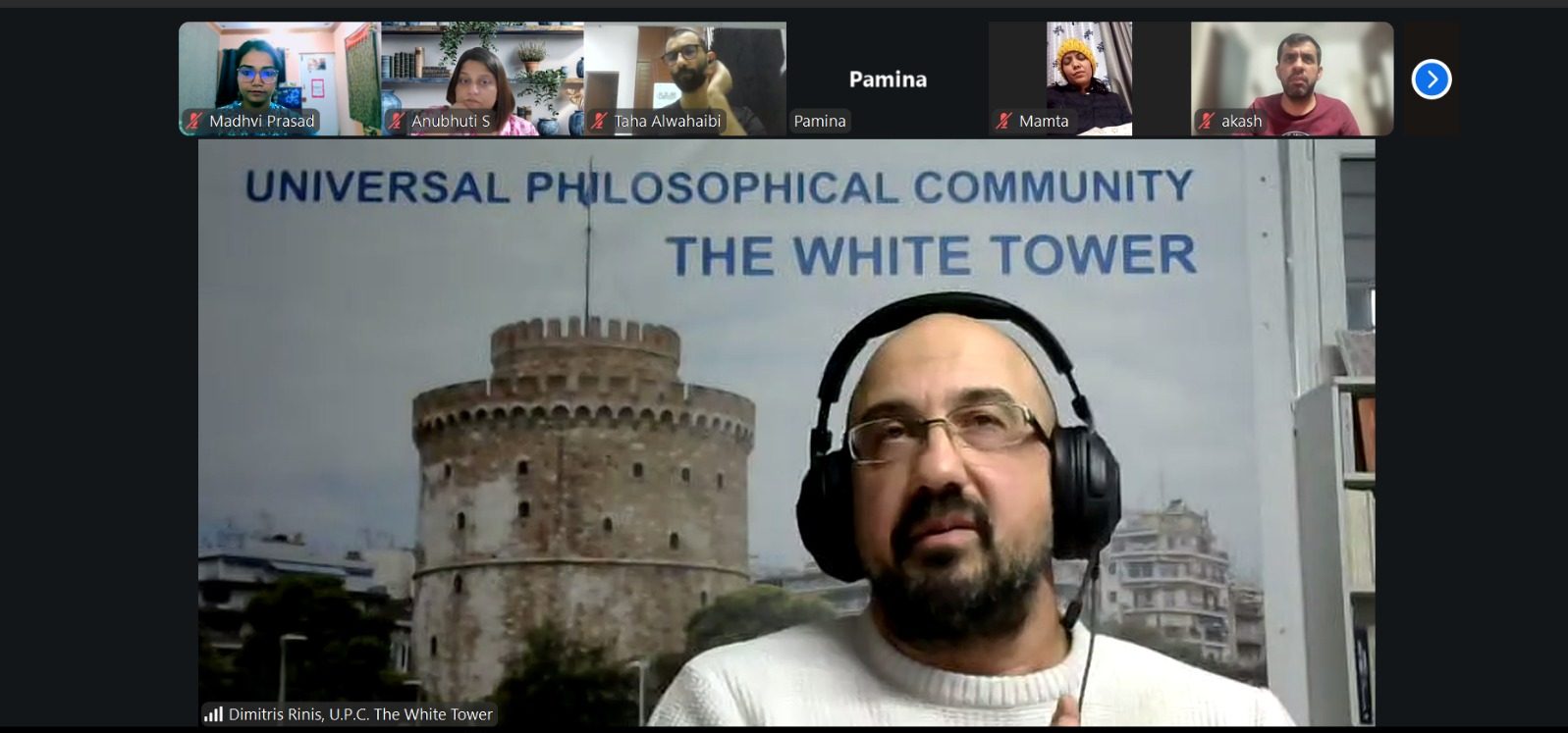
These themes formed the background for the session, which was further explored through the philosophical reflections of Dimitris Rinis, Founder of the Universal Philosophical Community, “The White Tower”, U.P.C.
Participants were invited to join our private Philotreat group—a reflective space guided by shared values and dialogue—where such discussions continue beyond individual sessions.
Meaning, Nihilism, and Heidegger’s Question of Being
The discussion drew from philosophical works written by the mentor of our philosophical community and centered on Martin Heidegger’s engagement with the meaning of life.
After the proclamation of the “death of God,” many philosophers argued that life is fundamentally meaningless. Nietzsche resisted this conclusion, not by returning to fixed doctrines, but by encouraging individuals to create meaning through self-reflection. Two major positions emerged in this debate: one claiming that life is universally meaningless, and another suggesting that even if life lacks a universal meaning, individual lives can still be meaningful.
Heidegger takes a different path. For him, meaning is not grounded in the isolated individual but in being-in-the-world, which he names Dasein. Human existence is always relational and communal.
Heidegger describes the modern human condition as one of homelessness—not a lack of physical shelter, but a loss of belonging. Despite living among others, we feel uprooted and alienated. He characterizes this condition as a darkening of the world, marked by the flight of the sacred, destruction of the Earth, massification of humanity, and the promotion of mediocrity.
Philosophy, understood as the love of wisdom, calls us to move toward light—not by becoming wise, but by remaining seekers. Philosophical reflection must respond to this homelessness and ask how we coexist meaningfully with others.
Dwelling, Belonging, and Authentic Life
Heidegger warns against nihilism and instead urges reflection on the essence of existence. For him, the meaning of life converges with the meaning of being itself. Existence unites life-essence and being-in-the-world.
Dwelling is not merely about residing in a place. It refers to an existential struggle: resisting forces that dominate and alienate us, and learning how to live authentically. Dwelling asks a fundamental question—where do I truly belong?
Belonging is associated with light—clarity, rootedness, and historical continuity. Humans should not be uprooted from their existential, cultural, and earthly foundations. Heidegger emphasizes that we must become guardians of the Earth, resisting exploitative technological and ideological forces. Meaning arises only when we protect both ourselves and the world we inhabit.
Authentic dwelling opens a non-calculative relationship with things—one that is caring rather than consumptive. In this way, Earth, sky, divinities, and mortals are gathered into a meaningful whole.
Reflections from the Discussion
The discussion opened into reflections on exhaustion, multiple roles, unclear priorities, and the need to seek light rather than remain trapped in shadows. Participants explored what it means to dwell—not as a static destination, but as a movement.
Dwelling begins from where we are. It is a continuous journey of discovery, not attachment to a fixed endpoint. Meaning unfolds through walking the path, not clinging to a single conclusion. This process takes time and involves ongoing struggle.
One reflection addressed the human need for endpoints—destinations that make suffering feel meaningful. Religion often provides such frameworks by situating meaning in an afterlife. Heidegger, however, places meaning in the present struggle itself. Authenticity is not deferred; it is lived here and now, through engagement, responsibility, and care for the world.
Presence, Peace, and the Search for Meaning
A key question emerged: How does a person who has found meaning actually live?
The response emphasized movement rather than finality. Meaningful individuals pass through different stages—professional, personal, social—without assuming any stage is final. Nothing is wasted; every phase contributes to understanding where one belongs.
Another question followed: Is peace possible amid continuous movement?
Peace was described not as a destination, but as a way of being—found in presence, reflection, and balance. Modern life, driven by performance culture and constant connectivity, leaves little space for such presence. Loneliness, emotional exhaustion, and loss of motivation have become common conditions.
Being present does not mean the absence of unrest. As Dimitris noted, those striving for authenticity often experience continuous unrest—but this unrest is productive. It keeps one attentive, responsive, and open to truth.
Meaning emerges through community, engagement, and participation. Presence deepens understanding, even if it does not guarantee comfort.
Authenticity, Ego, and Self-Acceptance
The discussion returned to authenticity as self-acceptance and freedom from imposed identities. Authenticity is not something acquired; it is something gradually uncovered as layers of conditioning fall away.
Modern life intensifies self-surveillance through social norms and performance expectations. Heidegger’s concept of “the they” explains how anonymous standards dictate how we should live. Authentic moments arise when we act without seeking validation—when we are simply present.
A distinction was drawn between ego and self. Success and validation offer temporary highs tied to ego, while meaning arises from the self or soul, which does not depend on external approval. Ego, when kept subtle, can function as a boundary that protects inner peace. When excessive, it distorts happiness.
Authentic living, therefore, is not about eliminating ego, but understanding its role—allowing meaning to guide life rather than validation, and presence to anchor us in who we truly are.


PS: This blog is a summary of the Philotreat discussions held on 12th December’ 2025 with a presentation by Dimitris Rinis, an Educator, an English Language and Literature teacher, an adult education trainer, and the founder of the Universal Philosophical Community, “The White Tower”, U.P.C. The White Tower.


Drop your thoughts below!