
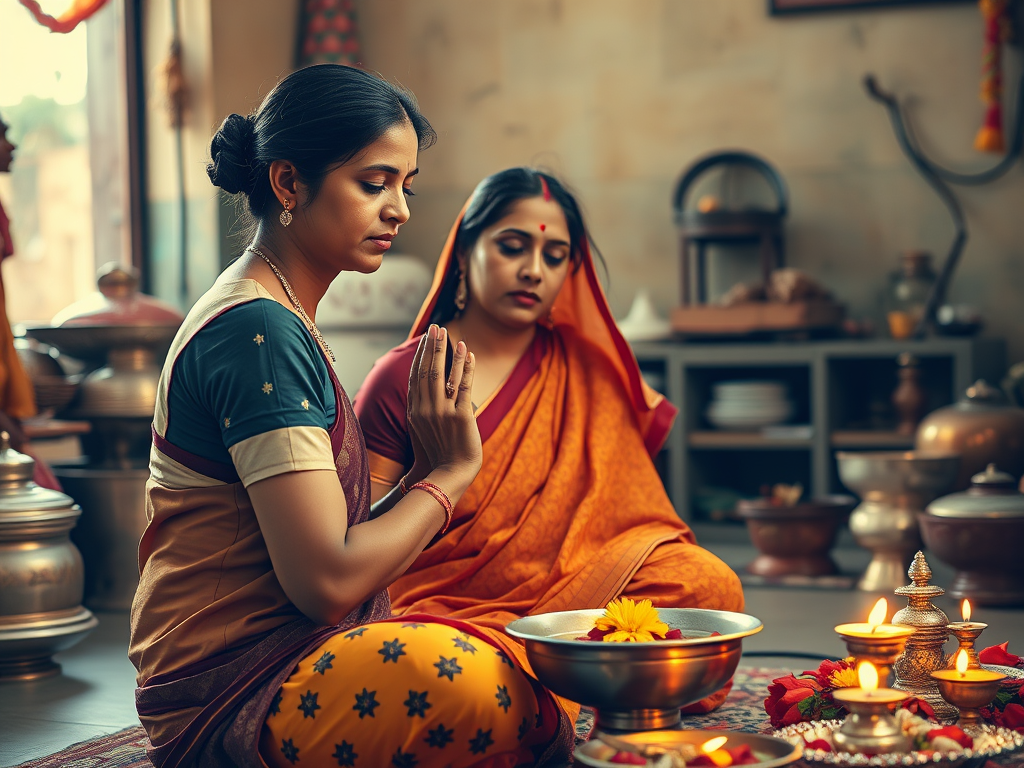
On Thanksgiving Day, we should appreciate and celebrate the caring nature of Indian women who give selflessly to their families without expecting anything in return. Here, we will explore the practices, beliefs, rituals, and ceremonies that help women grow spiritually and express their love.
Let’s reflect on Indian women or Indian housewives who manage family duties and household chores. They follow Grihasthashram—a key life stage of marriage and domestic roles. Their daily struggles are often hard to understand. These women carry overwhelming responsibilities, balancing care for their loved ones with their own physical and mental health. They nurture their unique spiritual beliefs, including customary practices and devotions that often go unnoticed. Indian women embody an advanced form of spirituality that we must reflect upon.
The Spiritual Strength of Indian Women: Practices and Beliefs
Upon thinking about spirituality and religious devotion, the image that often comes to mind is that of an ascetic meditating in solitude or a priest performing sacred rituals. However, a rich and advanced form of spirituality exists within the everyday lives of Hindu women. It is activated as they fulfill their duties, practices, and beliefs. Numerous studies reveal that Hindu women practice a unique form of spirituality that transcends traditional boundaries, making their contributions essential not just to their families but also to the spiritual progress of society as a whole.

The Pillars of Household Spirituality: Grhasthasrama
At the heart of Hindu religious life is the concept of Grhasthasrama, or the householder stage of life. This is where women play an important role as the ideal homemakers, nurturing not just the physical well-being of their families but also ensuring the spiritual purity of the household. This is no small feat; it requires a deep understanding of their prescribed duties, which are interconnected with a range of religious practices and rituals that highlight their commitment to both family and faith.
Indian culture historically places significant focus on the household as a sacred space, wherein women are seen as the guardians of tradition. Their adherence to customary practices brings a sense of continuity and stability. From morning prayers to intricate ceremonies marking life’s milestones, women’s roles are foundational to maintaining the auspicious energy within the home.
Self-Effacing Grace and Interpersonal Relationships
Indian women often include traits of self-effacement and self-denial, which shape their interactions with others. These cultural expectations promote a lifestyle centered around service, sacrifice, and giving. Yet, this selflessness does not equate to a lack of personal agency or fulfillment. Instead, the commitment to these values promotes an intricate balancing act where women derive a sense of purpose and empowerment through their devotion to family and religion.
By prioritizing the health and longevity of their children and husbands, women serve not only their immediate household but also care for the wider lineage, ensuring prosperity that transcends generations. It is through these everyday actions—the prayers, the rites, and the innumerable vows and fasts—that Hindu women manifest a spirituality grounded in love, responsibility, and deep-seated belief.

The Role of Devotionalism in Women’s Religious Practices
Devotion is a main element of women’s spirituality in Hinduism. From childhood rituals that establish their connection to the divine to adult practices that solidify their roles within the family structure, women engage in a broad spectrum of religious activities. Ethnographic studies show that these practices often have a dual nature, revealing a self-interest alongside societal duty. Women find fulfillment in their religious observances, which not only serve familial obligations but also enrich their spiritual lives.
Each ritual performed by a woman—whether it’s a daily puja, a festive celebration, or a sacred vow—is imbued with intention and significance. These actions reinforce cultural bonds and provide a framework for women to express their faith in tangible ways. The act of devotion is not only a personal journey but also a means of cultural continuity, building community, and solidarity among women.
Let us see in tabular form the life and aspect of Indian woman
| Aspect | Description |
| Household Rites and Rituals | Indian women transform their homes into sacred spaces through daily pujas, mantra chanting, and lighting diyas, reflecting the grhasthasrama (householder) ideal. |
| Preservers of Ritual Purity | They ensure spiritual and physical purity in their homes by following cleanliness practices and adhering to auspicious timings for rituals and prayers. |
| Vows and Fasts | Women observe vratas (vows) and fasts, like Karva Chauth and Vat Savitri, for their families’ health, longevity, and prosperity, showcasing devotion and self-sacrifice. |
| Devotionalism (Bhakti) | They embody bhakti by singing bhajans, crafting kolams, and bringing a personal and emotional connection with the divine, central to their spiritual lives. |
| Childhood Religious Foundations | Early exposure to rituals and festivals, like Navaratri, guarantees lifelong spiritual values and prepares them for familial and societal roles. |
| Guardians of Lineage Prosperity | By worshipping deities and plants like Tulsi, they ensure divine blessings, health, and prosperity for their families and lineage. |
| Self-Effacing Spirituality | Their spirituality involves self-denial, prioritizing family and community needs, embodying virtues of humility, care ethics, patience, and endurance. |
| Personal Religious Fulfillment | Studies reveal their personal spiritual cravings, fulfilled through storytelling (kathas), pilgrimages, and charitable acts, balancing family devotion with self-care. |
| Integration of Spirituality in Life | Unique spirituality is intertwined with daily chores, such as cooking and cleaning, performed with devotion and accompanied by prayers and mantras. |
| Commitment to values | Indian women are highly committed to securing values. All this is a result of consistent duties and holding the right beliefs. |
| Festivals that grow the spirituality of woman | Navaratri, Karva chauth, Teej, Vrat rituals, Vat Savitri Vrat, Gauri Puja, Diwali, Gangaur, Durga ashtami. |
Conclusion:
The spiritual journey of Indian women is multifaceted. It is rich with tradition, duty, and devotion. They serve as the bedrock of familial and societal spiritual life, ensuring that the lineage thrives while cultivating their own spiritual richness. When we go deeper into the world of popular religions and traditions in India, it becomes abundantly clear that these women, through their daily practices and unstoppable faith, offer an excellent understanding of spirituality that may often fly under the radar.
In the end, the spirituality of Indian women reflects their religious duties, showcasing the strength, resilience, and grace they contribute to their families and society. This exploration offers a glimpse into their spiritual world, highlighting the lasting impact of their selfless devotion.
What do you think of this post? If you feel the same, don’t forget to comment and add your opinion.
Also, I recently published a game-changing book titled “Growth is Forever – How to Become Yourself.” Are you ready to explore your growth journey? If you’re serious about transforming yourself or want to empower others, you better grab this book now. Check out the link and don’t miss out!
Have you checked our other platforms?
Thank you for your support. Please like and comment to help us improve our blogs and provide more interesting content for you.


Drop your thoughts below!